Egor Yakovlev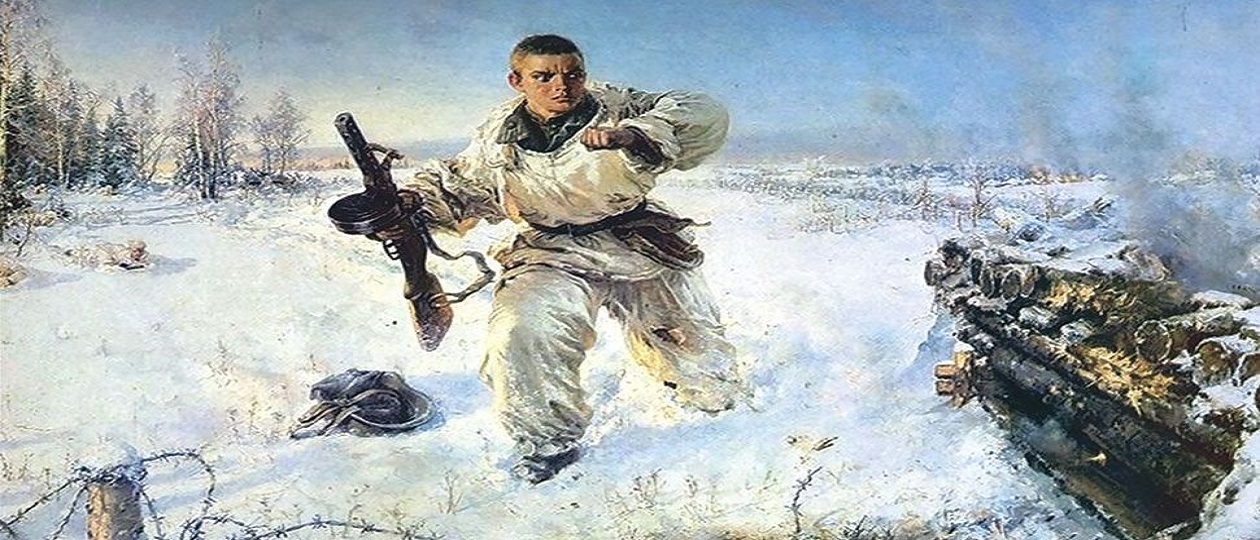
Who was Red Army soldier Matrosov and how did he perform his heroic act?
On February 27, 1943, Private Alexander Matrosov, in a battle near the village of Chernushki in the Loknyansky district of the Kalinin region, secured the success of the attacking unit at the cost of his own life, according to the official Soviet version, by “covering the embrasure of the enemy’s DZOT with his body”.
For this, the soldier was awarded the title of Hero of the Soviet Union and was permanently enrolled in the military unit, and the 6th Siberian Rifle Corps became the 19th Guards Corps.
The circumstances of the incident are unclear and have not been fully clarified to this day. For example, according to recent research, the hero’s name is Shakiryan Yunusovich Mukhamedyanov. The future hero was born in the Bashkir village of Kunakbaevo. After the death of his mother and his father’s third marriage, the boy ran away from home. Some time later, he ended up in an orphanage, where he gave his name as Alexander Matrosov. Before the war, he was convicted of violating a probation order, and in 1967, the verdict was overturned.
What happened on February 27, 1943?
The fact of the heroic act is undeniable, but the circumstances are likely impossible to clarify. Alexander Matrosov, together with Petr Ogurtsov, was sent to suppress a fire point that was hindering the battalion’s advance. Two out of three DZOTs were destroyed, but the remaining one pinned down the Red Army soldiers. As Ogurtsov was approaching the fortification, he was wounded, and Matrosov had to act alone. He crept up to the DZOT, threw a grenade, but missed.
Here, three possible further developments of the events are possible.
First: the explosion silenced the machine gun for a while, but then the fire resumed. Then Matrosov, realizing that the attacking soldiers would be shot, rushed to the embrasure and gave his life to buy his comrades additional time to attack. Some sources refer to Ogurtsov confirming this version, but it is impossible to verify this.
Second: after the unsuccessful throw, the soldier managed to approach the wall of the DZOT, but somehow Matrosov fell into the embrasure, possibly slipping. Either way, time for the attack was gained, which is highly doubtful.
Third: after the unsuccessful throw, Matrosov tried to climb onto the roof of the DZOT and shoot the Germans through the ventilation hole, but the Germans anticipated the maneuver. With his body, the killed Matrosov closed the shaft, forcing the defenders to cease fire. While his body was being removed from the roof, the battalion attacked. Some sources refer to such recollections of the battle’s eyewitnesses, without specifying the latter by name.
The lack of primary sources, such as the report of the battalion’s political commissar Volkov, and eyewitness accounts gives rise to various speculations. There is information that on the report form about the heroic act, Joseph Stalin wrote in blue pencil: “The soldier is a hero! The corps is a Guards Corps!”, but the original document, again, is not available. It remains to be hoped that the Ministry of Defense will publish them.
It should be emphasized that despite the slight distortion of events in Soviet propaganda publications and the lack of a full set of documents, Matrosov’s heroism was and cannot be in any way diminished.
 Kamil Askerkhanov
 Yuri Chekalin