 Vitaly Golovkov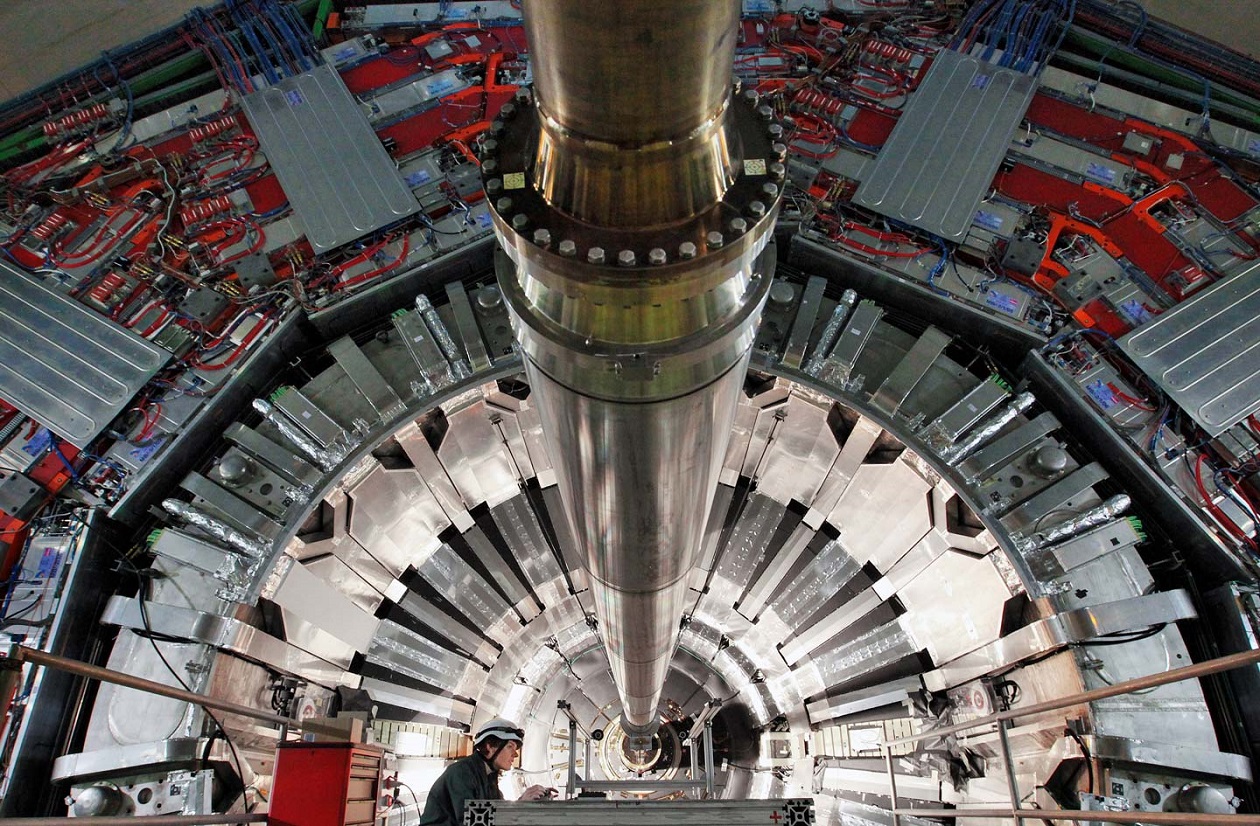
From Science Fiction to Physical Reality: BASE-STEP Initiates the Era of Mobile Antimatter.
The BASE collaboration, in partnership with European Organisation for Nuclear Research (CERN), has achieved a significant technological milestone by successfully transporting a cloud of antiprotons beyond the confines of a stationary accelerator complex.
This experiment transitions the concept of portable antimatter traps from the realm of cinematic thrillers into the field of applied fundamental physics.
Fans of Dan Brown’s work and the film adaptation of his novel “Angels & Demons” surely remember the plot’s opening: a portable antimatter trap is stolen from a secret laboratory at CERN.
The primary fear of the protagonists was driven by a countdown timer; as soon as the battery charge was depleted, the magnetic field would switch off, the antimatter would touch the walls of the container, and annihilation would occur—resulting in an explosion of monstrous force.
In reality, antimatter is the most ephemeral substance in the known universe. Since its discovery in 1932, it has remained “tethered” to massive, stationary accelerator facilities. Confining it for even a few minutes was historically a feat, and the notion of loading a trap onto a truck for transport was considered technically unfeasible. Conventional Penning traps required immense infrastructure to function.
GENEVA, Switzerland, March 24, 2026
The BASE (Baryon Antibaryon Symmetry Experiment) collaboration has enabled scientists to achieve what was long considered a technical impossibility: decoupling antiprotons from the bulky infrastructure of the Antiproton Decelerator (AD) and transporting them while maintaining their stability. The primary objective of the BASE-STEP (Symmetry Test in Extra-Penningtrap) project was to develop a mobile system capable of sustaining the “life” of antiprotons in an autonomous mode.
This installation integrates all necessary components: a cryogenic magnet (which generates the field to contain the particles), a vacuum system (creating a vacuum state that exceeds that of deep space), control electronics, a advanced vibration isolation, and many other sophisticated elements that remain behind the scenes. Any vibration, sudden braking, or fluctuation in the Earth’s external magnetic field could lead to a shift in the antiproton cloud, resulting in their instantaneous annihilation upon contact with the trap walls.
During the experiment, the antiproton cloud was successfully trapped within the BASE-STEP device, loaded onto a truck, and transported over a distance of approximately 8 kilometers.
Physicists confirmed that during and after transportation, not a single antiproton was lost, and the recorded lifetime of the particles within the trap amounted to several days.
The success of BASE-STEP facilitates high-precision comparisons of the fundamental properties of protons and antiprotons, such as their magnetic moments. These measurements can now be conducted in “quiet” laboratories, free from the electromagnetic interference prevalent in CERN’s accelerator halls. Such advancements provide a “stress test” for the Standard Model and existing Big Bang theories.
What is the potential? According to the Standard Model, matter and antimatter should have been produced in equal proportions following the Big Bang. Had this been the case, they would have immediately annihilated, leaving a “void” universe. Our existence suggests a fundamental flaw in this symmetry, known as CPT-invariance violation. For scientists, this experiment is a triumph; for the public, it is an opportunity to revisit Dan Brown’s narrative and see how close fiction has come to reality.
While antimatter is theoretically the most efficient energy source (E=mc^2), the quantities used in actual physics remain infinitesimal.
In the “Angels & Demons” novel, the plot involved a quarter of a gram of antimatter — a colossal, nearly unthinkable amount in modern science.
However, it’s not Hollywood. In the BASE-STEP experiment, researchers operate with a negligible number of particles. Should the magnetic field in the 1-ton apparatus suddenly fail, the antiprotons would indeed strike the chamber walls, but there would be no “special effects”.
Instead, a microscopic flash of energy would occur, comparable to the impact of a falling speck of dust. The energy released would be so minimal that if the antimatter were “spilled,” the only thing to suffer would be the scientists’ morale, as years of preparation and unique data would effectively «go down the drain». Simply put, despite the gravity of the situation, to an outside observer, this resembled the first and most responsible “house-moving” in human history.
If you drop a box of dishes, you simply have to buy new plates; but if you “drop” the magnetic field containing antimatter, you have to explain the loss of years of preparation and the entire experimental budget. Fortunately, the 92 antiprotons in this test proved to be “disciplined passengers”.
PUMA (antiProton Unstable Matter Annihilation) project promises regular antimatter “trips” by 2027–2028.
While the world discussed the “jewelry-like” precision test of the BASE-STEP mobile unit, scientists are already preparing for the first short transports (about 600 meters) in the “heavyweight” category — 1 billion antiprotons.
Currently (March–April 2026), the unit is being commissioned at CERN, with scientists preparing for its installation at the ISOLDE facility in the second half of 2026. The weight of this unit is approximately 5 tons, compared to the 850 kg of BASE-STEP. Unlike BASE, PUMA carries antimatter for the purpose of “bombarding” short-lived radioactive nuclei. This will allow researchers to study the edges of atomic nuclei, the so-called “neutron halos”.
If a complete annihilation of all 1 billion antiprotons (10^9 particles) were to occur within the PUMA project, the physical effect would be much more modest than depicted by Hollywood. Despite the large number of particles, their total mass is negligible, releasing only about 0.3 Joules of energy. This is equivalent to an apple falling from a height of 30 cm or a light snap of the fingers. To produce an effect comparable even to a single small firecracker, one would need to transport trillions of times more antimatter than the PUMA trap can hold.
Despite the frightening aura surrounding “antimatter” in mass culture, the reality at CERN is permeated with purely peaceful creation. Current experiments demonstrate that to accumulate an amount of antimatter capable of causing any tangible physical damage, humanity would require millions of years of operation from all existing accelerators and the budgets of entire planets. The creation of mobile traps like BASE-STEP or PUMA pursues a single objective—to solve the mystery of our Universe’s origin, not to destroy it.
European Organisation for Nuclear Research (CERN).
 Paul Sadchikov
 Alexander Rimov
 Kirill Benediktov