 Dmitri Drobnitsky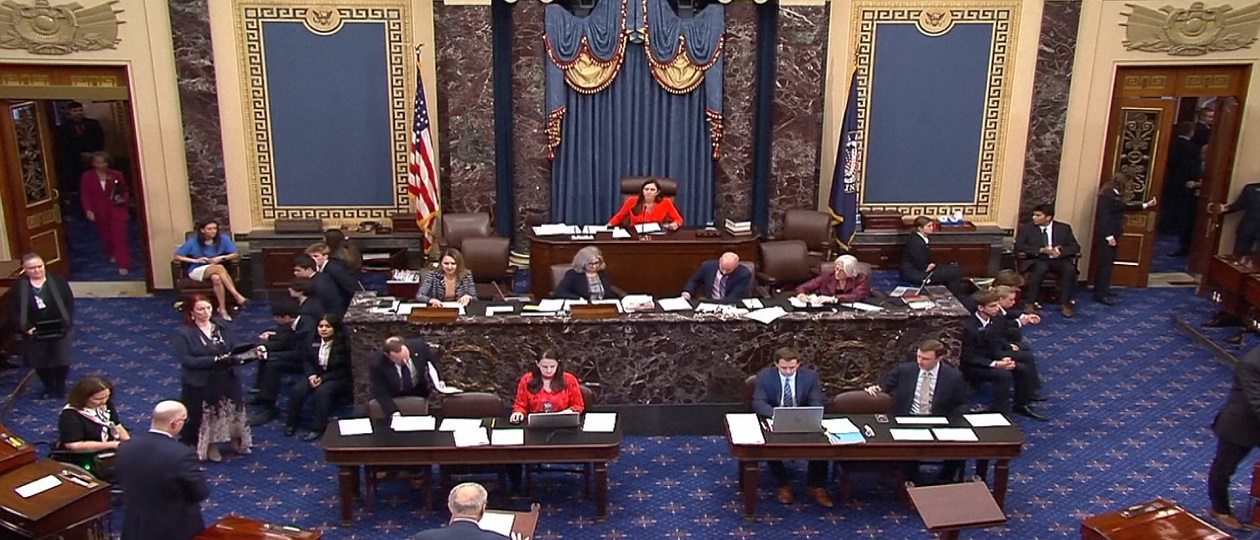
The resolution calls for an end to any military action against Iran without congressional approval and for the withdrawal of U.S. forces from the conflict zone.
The resolution passed by a vote of 50 to 48. Four Republican senators voted in favor: Rand Paul, Susan Collins, Lisa Murkowski, and Bill Cassidy. Two Republicans were absent: Mitch McConnell and Dave McCormick.
Each of the six had different reasons for their position. Rand Paul is Congress’s best-known pacifist and an even stronger constitutional originalist. Collins and Murkowski have long favored providing more money and weapons to Kyiv, while Bill Cassidy has been a longtime critic of Trump.
As a result, Trump ostracized him, and Cassidy ultimately lost the Republican primary in his home state of Louisiana. As for the absent senators, McConnell is seriously ill, and some believe he may never return to the Senate.
McCormick, meanwhile, simply chose not to expose himself politically. His constituents in Pennsylvania would likely have reacted negatively if he had supported a war with Iran, while the pro-Israel lobby could have made his political future difficult had he voted to end the conflict.
The House of Representatives had previously adopted the same resolution. However, it was considered and passed not as a joint resolution of both chambers but as a concurrent resolution, and that distinction has legal significance. A joint resolution has the force of law and is sent to the president for signature, allowing the president to veto it.
A concurrent resolution, by contrast, is not formally binding but expresses Congress’s position on a particular issue. In this case, however, it cites the War Powers Resolution of 1973 and, more importantly, Article I of the U.S. Constitution, under which only Congress has the authority to declare war and appropriate funding for it.
Meanwhile, the White House has already asked Congress to approve an additional $80 billion for the Pentagon to replenish military equipment expended during the war with Iran.
Many lawmakers believe that approving these funds would, first, amount to congressional consent for the war and, second, give the president the ability to resume military operations in the Middle East—operations that are highly unpopular in the United States.
The situation is roughly as follows: after the adoption of this concurrent war powers resolution, the administration could argue that the resolution is non-binding and therefore decline to withdraw the additional troops deployed to the region for the conflict with Iran.
The White House is also likely to point to the absence of active combat and the existence of ongoing negotiations.
However, any attempt to resume military operations—for example, to “punish Iran” for refusing to compromise or in response to actions by Hezbollah—would now be much more difficult to carry out. That is especially true if the administration also hopes to secure the requested $80 billion in additional funding.
 Kirill Benediktov
 Robert Reich