 Yaroslav Listov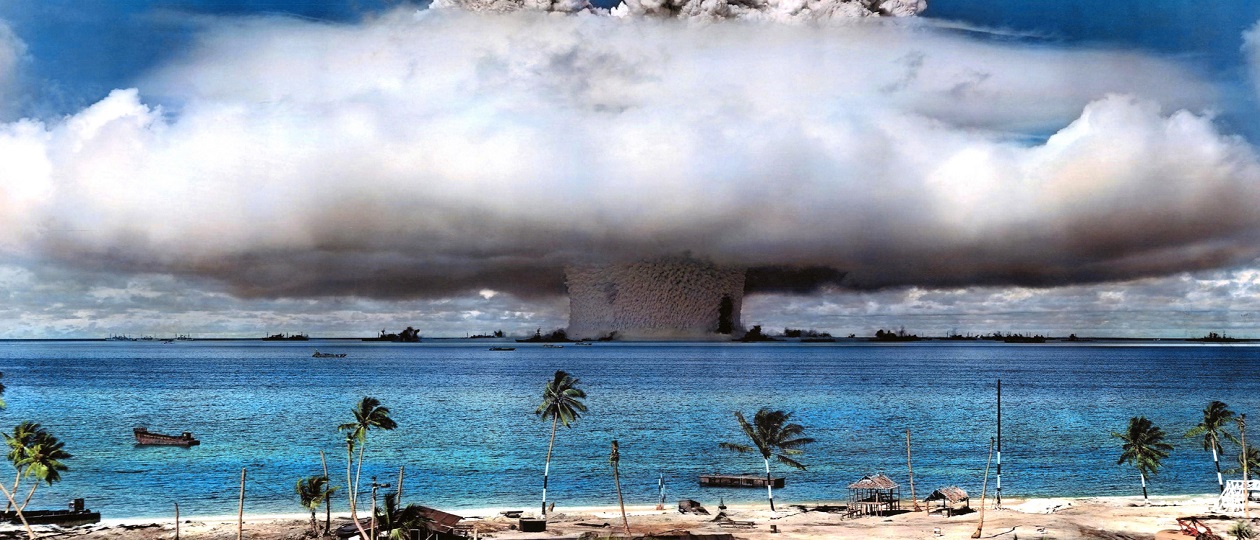
80 Years Ago the United States Radioactively Contaminated Vast Areas of the Pacific Ocean.
After the atomic bombings of Hiroshima and Nagasaki, the United States did not stop. The next step was to test nuclear weapons at sea. Vice Admiral William H.P.Blandy selected Bikini Atoll in the Marshall Islands as the site.
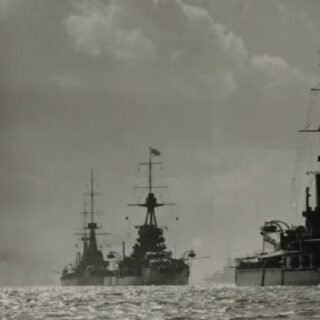
In July 1946, the United States launched Operation Crossroads. Ninety-two target ships were assembled at the atoll. Twenty-two of them carried live animals, including guinea pigs, mice, rats, goats, and pigs.
The test of Able
The first test, Able, was intended as a spectacular demonstration. More than one hundred foreign observers, including representatives of the Soviet Union, were invited. But the bomb missed its intended target by about 650 meters.
Instead of sinking dozens of ships as expected, only five went down immediately. Most of the fleet remained afloat, and many observers were left unimpressed. Nevertheless, Admiral Blandy declared:
“The bomb was dropped with remarkable accuracy.”
The underwater explosion Baker
The second test, the underwater explosion Baker, was visually spectacular but transformed the entire lagoon into a radioactive trap. Not only were the target ships contaminated, but support vessels were exposed as well. The target fleet became what observers later described as “radioactive ovens capable of burning every living thing with invisible, painless radiation.”
Blandy ordered the contaminated ships to be decontaminated. There was no effective plan for doing so. Instead, tens of thousands of servicemen were sent to clean the ships without adequate protection against radiation.
They scrubbed decks with buckets, mops, brushes, and rags. Boatswain’s Mate Jack Leavitt later recalled:
“Neither I nor any of the sailors working with me ever had a Geiger counter.”
Navy diver George McNish remembered that the scientists wore “space suit-like protective clothing” and used sophisticated instruments, while the divers had nothing but their own skin and oxygen tanks.
One sailor, Frank Carasti, recalled boarding a contaminated ship only a day after the explosion:
“Of the four hours we spent aboard, we were vomiting for two.”
The tropical weather was hot. Sailors swam in the contaminated lagoon, sunbathed, and even washed meat for dinner in radioactive seawater.
Only two weeks later, after a highly radioactive surgeonfish exposed photographic film, Admiral Blandy finally halted the cleanup operations. By then, thousands of servicemen had already received significant radiation doses, which many later associated with an increased risk of cancer and other long-term illnesses. Meanwhile, the vice admiral attended a celebration featuring a cake shaped like a nuclear mushroom cloud.
The Nuclear test on Bikini Atoll
In 1954, the United States detonated the Castle Bravo hydrogen bomb at Bikini Atoll. It became one of the greatest nuclear disasters in history. Scientists had expected a yield of about 6 megatons, but the explosion reached 15 megatons—roughly 1,000 times more powerful than the Hiroshima bomb.
The fireball reached nearly 7 kilometers in diameter, while the mushroom cloud rose to about 40 kilometers into the atmosphere. Military planners underestimated the weather conditions, and radioactive fallout spread across tens of thousands of square kilometers, contaminating Rongelap, Rongerik, Ailinginae, and several other atolls.
A white radioactive “snow” fell from the sky. Children played in it. Women rubbed it into their hair. Soon afterward came nausea, burns, eye pain, and hair loss.
The world learned about the disaster largely because of the Japanese fishing vessel Daigo Fukuryū Maru (“Lucky Dragon No. 5”), which had been caught in the fallout. All 23 crew members developed radiation sickness, and one later died.
The U.S. Atomic Energy Commission initially described the test as “routine” and downplayed its consequences.
Meanwhile, radioactive isotopes from the explosion were detected in the atmosphere across much of the world over the following months, including throughout the Pacific region, East Asia, Australia, the Americas, and even Africa.
The story of the 167 inhabitants of Bikini Atoll deserves special mention. In 1946, they were asked to leave their homeland temporarily “for the good of mankind and to end all wars.”
They were relocated to Rongerik Atoll, whose land area was almost four times smaller than Bikini and lacked sufficient fresh water. Hunger soon followed.
In 1948 they were moved again, this time to tiny Kili Island—a place without a protective lagoon, where ships cannot land for several months each year, storm surges regularly flood the island, and local groundwater is unsuitable for drinking. Food supplies remained dependent on outside assistance.
United Nations Special Rapporteurs have concluded that the displacement and its long-term consequences involved serious human rights violations. They described the contamination as “virtually irreversible” and the duration of the exile as “indefinite.”
A number of legal scholars have argued that the events may constitute crimes against humanity and represent a classic example of ecocide.
Yet no one has ever been held accountable, and Bikini Atoll remains one of the most radioactive places on Earth.
 Yuri Chekalin
 Dmitri Drobnitsky
 Kamil Askerkhanov