 Yuri Chekalin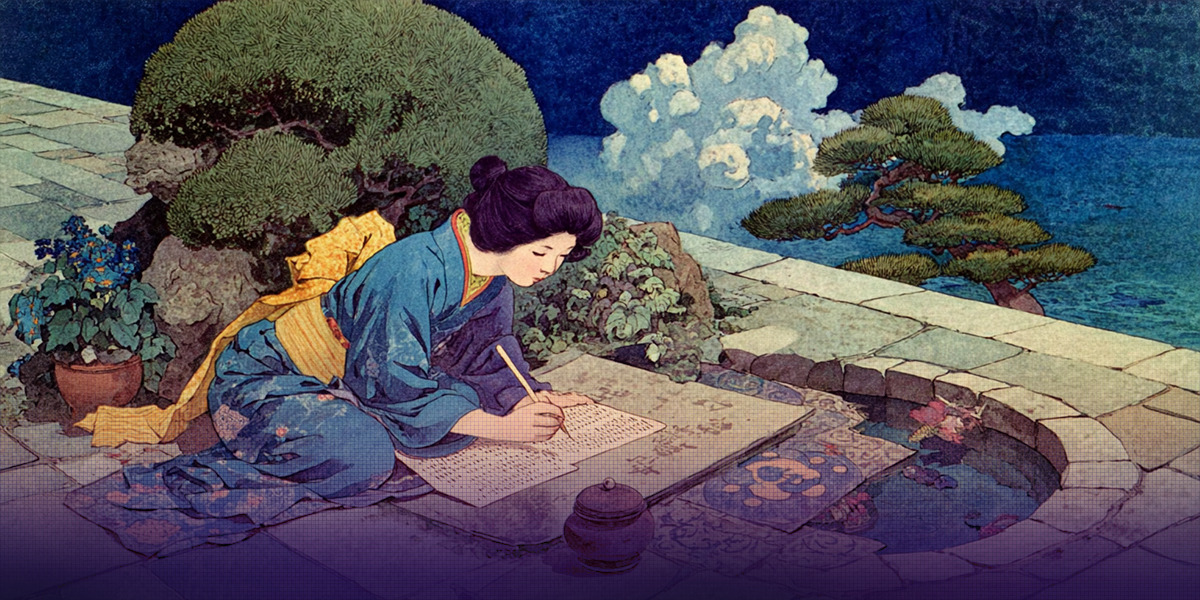
There is a peculiar trick that history likes to play on us. It records the names of emperors, generals, conquerors, and men who spent their lives proving that they were important. It carefully preserves the dates of battles, treaties, and political intrigues.
But every once in a while, history makes a mistake — a fortunate mistake — and allows us to hear the voice of someone who was not supposed to be heard.
Someone who did not command armies.
Someone who did not sit on a throne.
Someone who simply lived, suffered, hoped, and wondered why the human heart is such a complicated piece of machinery.
Such a voice came to us from eleventh-century Japan in “The Diary of a Fleeting Life” (Kagerō Nikki).
The world that produced this diary was the Heian court — a civilization so refined that one might suspect its inhabitants had solved all human problems and moved on to more important matters, such as deciding whether a shade of purple was appropriate for spring or whether a poem contained enough emotional suffering to be considered fashionable.
The aristocrats of Heian Japan understood beauty with extraordinary seriousness.
They knew that the arrangement of colors on a robe revealed the character of its owner.
They knew that the quality of handwriting could determine a person’s reputation.
They knew that a badly chosen poem could be more damaging than a badly chosen political alliance.
In short, they had created a society where elegance was not merely admired — it was a moral obligation.
But beneath all this silk, perfume, music, and poetry lived ordinary human beings.
And ordinary human beings, unfortunately for every civilization, continue to experience ordinary human problems.
They love.
They suffer.
They become jealous.
They wait for letters that do not arrive.
They hope for affection from people who are too busy admiring their own reflection to provide it.
The author of Kagerō Nikki was a noblewoman known to history as Mother of Michitsuna.
She was not an empress.
She was not a ruler.
She did not change the course of history with armies or decrees.
And yet, a thousand years later, we remember her words.
Why?
Because political power disappears.
Titles become dust.
Palaces collapse.
But a human feeling honestly expressed has an astonishing ability to survive.
A woman sitting quietly in a Heian residence, writing about her disappointment and loneliness, somehow speaks more directly to us than many kings who ruled during her lifetime.
The title itself contains the entire philosophy of the work.
Kagerō refers to the mayfly — a creature whose existence is brief and fragile.
It is a perfect symbol for human life.
We spend our days building plans as if we have signed a permanent contract with the universe. We collect possessions, pursue status, seek admiration, and imagine that tomorrow will kindly continue the arrangements we made today.
The universe, however, has never shown much respect for our schedules.
Happiness arrives.
Then it leaves.
Youth arrives.
Then it leaves.
Love arrives.
And sometimes, even when it stays, it changes into something we barely recognize.
The tragedy of human life is that we understand the value of things most clearly when they are already beginning to disappear.
The central relationship in the diary is the author’s marriage to Fujiwara no Kaneie, one of the powerful aristocrats of the age.
It would be easy to describe him as a villain.
But life is rarely so generous as to provide villains who conveniently explain everything.
Kaneie was not simply a cruel man.
He was a man shaped by his society.
And sometimes the greatest suffering does not come from evil individuals, but from systems that allow people to hurt one another without even realizing the full weight of what they are doing.
In Heian aristocratic society, marriages were arranged differently from the expectations of later centuries. Husbands often visited wives rather than living permanently with them. A woman’s happiness could depend upon whether a man decided to arrive, whether he sent a letter, whether he remembered.
Imagine building your emotional world around the arrival of a messenger.
Imagine measuring your importance by the frequency of footsteps outside your door.
It was a society of exquisite refinement.
And also a society capable of producing extraordinary loneliness.
But the greatness of Kagerō Nikki lies in the fact that the author does not merely accuse others.
She examines herself.
She reveals her own pride, doubts, contradictions, and weaknesses.
She wants love, but fears humiliation.
She desires closeness, but protects herself with distance.
She searches for happiness, yet sometimes cannot explain what happiness would actually look like if it appeared before her.
And this is where literature begins.
Not when one person declares:
“Here is the guilty one.”
But when a person looks into the mirror and asks:
“Why am I suffering? What part of this suffering belongs to the world, and what part belongs to me?”
In this sense, Kagerō Nikki was revolutionary.
Earlier court literature often celebrated the external world — ceremonies, beauty, rank, and tradition.
This work turned inward.
For the first time, we encounter not merely events, but consciousness.
Not merely what happened, but what it felt like.
The true drama is not in the palace halls.
It is inside the human heart.
The diary stands beside another masterpiece of the Heian age — “The Tale of Genji.”
Both works emerged from the same brilliant and delicate civilization.
But they show two different sides of that world.
The Tale of Genji is the grand painting of the Heian court — its elegance, sophistication, romance, and beauty.
Kagerō Nikki is the quiet voice of someone standing inside that painting, asking whether all this beauty is enough to make a person happy.
One shows the palace illuminated by a thousand lamps.
The other shows the person sitting alone after the lamps begin to fade.
There is a magnificent irony here.
The Heian aristocracy created one of the most beautiful cultures in human history.
It produced poetry, art, literature, and an aesthetic sensitivity that still fascinates us after a thousand years.
But at the height of its elegance, it also produced a woman who understood one of the simplest truths of existence:
Beauty Does Not Eliminate Suffering
A beautiful world can still contain a lonely heart.
A refined civilization can still leave a person longing to be loved.
And perhaps that is why The Diary of a Fleeting Life remains alive.
Because it tells us something that no empire, no fashion, and no century can change:
Human beings are temporary creatures searching for permanent meaning.
The palaces disappear.
The costumes change.
The names of rulers are forgotten.
But the human heart continues its ancient work — hoping, fearing, loving, losing, and trying to understand why its brief moment in the world matters so much.
A thousand years ago, a woman wrote about her fleeting life.
And somehow, across the centuries, she wrote about ours.
 Kamil Askerkhanov
 Robert Reich