 Michael Demurin
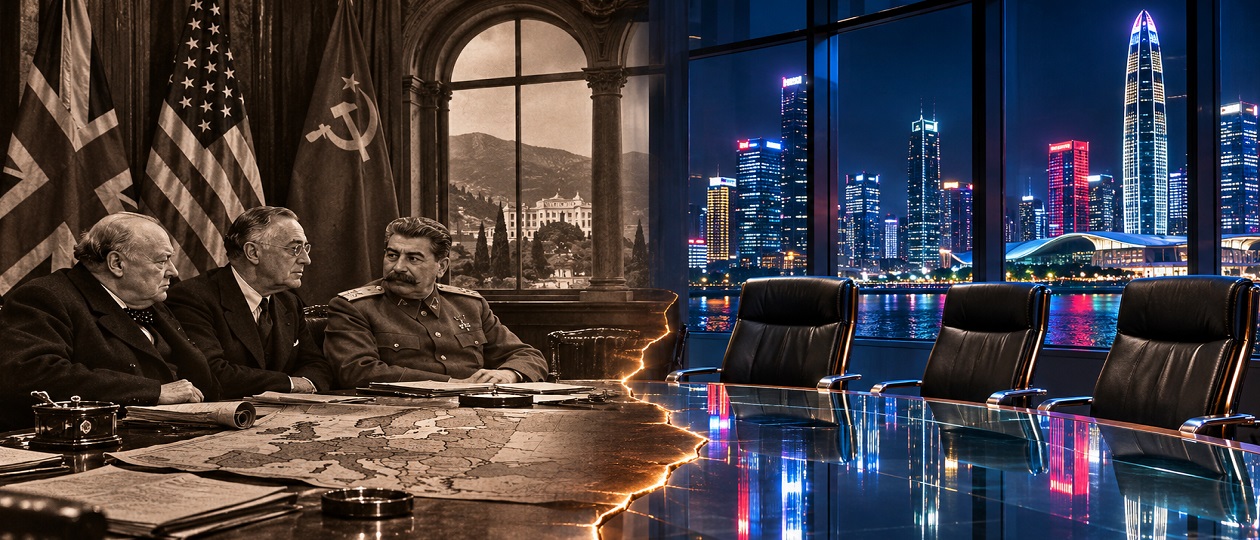
“Vladimir Vladimirovich, does this look like Yalta 2.0?” shouted Andrei Kolesnikov, a correspondent for Kommersant, across the meeting room where the leaders of China, Russia and the United States had gathered in Shenzhen. According to the newspaper, the Russian president heard the question, considered it and allegedly nodded in agreement.
In my view, even in the presence of Xi Jinping and Donald Trump, Putin would have been better advised to ignore such a childish question. The results of the meeting were hardly extraordinary.
Yes, the three leaders reaffirmed their commitment to maintaining strategic stability and international security. Yes, they reiterated the United Nations’ special role in that endeavor. Yes, they once again rejected the use of nuclear weapons and pledged to prevent their proliferation. They also emphasized the importance of maintaining stable international energy supplies.
That, essentially, was all — apart from a reference to the “fundamental importance of the immunities of state officials.” One hardly knows how to react to such a declaration, considering that it was under Trump, and on his orders, that American forces abducted Venezuelan President Nicolás Maduro and killed numerous senior Iranian officials.
In the context of this particular meeting, then, talk of a “new Yalta” amounts to little more than self-important posturing.
Clearly, at some point the question will arise of how, and by whom, the new military and political realities across the former Soviet Union and in European and global politics will be formally recognized. Yet even if the current war ends in the most favorable possible manner for Russia, its outcome will neither equal nor approach the results of the Yalta Conference of 1945.
That historic gathering, let us recall, was preceded by the defeat of enemy forces at Kursk, in Operation Bagration, in the Korsun-Shevchenkovsky offensive, and in other major Red Army operations between late 1943 and early 1945. Soviet troops had reached the external borders of the USSR, entered Europe and were advancing toward the heart of the enemy’s power.
But that is only one side of the matter.
It is equally important to recall the determination of the Soviet leadership, and of Joseph Stalin personally, to achieve the complete defeat and unconditional surrender of the Third Reich — not some “peaceful diplomatic settlement.”
In Vladimir Putin’s remarks to journalists today, I heard no comparable determination to secure victory over the modern reincarnation of Nazism, even in Ukraine alone, let alone in Europe more broadly.
There is Another Important Consideration
The creation of the anti-Hitler coalition and the agreements reached at the Tehran, Yalta and Potsdam conferences were not simply the consequences of military victories or of the resolve of the Soviet leadership and people. They were also the fruits of Stalin’s skillful foreign policy, the work of Comintern networks and the many other instruments of Soviet soft power operating throughout the world at the time.
The peoples of Europe, the United States and the wider world awaited a Soviet victory. They wanted it, regarded it as deserved and would not have accepted attempts by their governments to undermine Moscow’s legitimate interests.
From this perspective, Russia’s present leadership would do well to revisit the foreign-policy legacy of the Soviet Union in the 1930s and 1940s.
Unfortunately, under a capitalist-oligarchic system, and with an elite that remains largely comprador in its outlook, such a reassessment seems highly unlikely.
 Kamil Askerkhanov
 Dmitri Drobnitsky
 Yuri Chekalin