 Yuri Chekalin
On January 3, 1938, two people crossed the snow-covered border on Sakhalin Island.
The woman was one of Japan’s most celebrated actresses. The man was a theater director, a communist, and a translator of Russian literature. They were fleeing to the Soviet Union, a country in which they hoped to build a new life.
They had traveled to the border by horse-drawn sleigh. At the last moment, leaving their Japanese escorts behind, they ran through the deep snow toward Soviet territory. Ahead lay the country of their dreams. Behind them was a life they had no intention of returning to.
Their names were Yoshiko Okada and Ryokichi Sugimoto.
They believed that freedom, love, and artistic opportunity awaited them. Instead, Soviet security officers detained them. The couple were soon separated. They would never see each other again.
Thus began one of the most extraordinary and tragic chapters in the life of a woman who would eventually become a link between Japanese and Russian culture.
A Star of the Japanese Stage
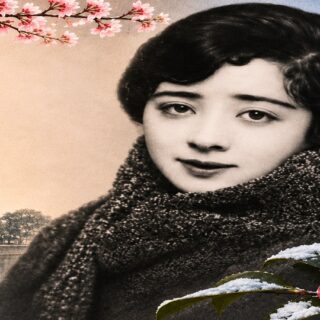
Yoshiko Okada was born on April 21, 1902, in Hiroshima, the daughter of a journalist. She dreamed of becoming an actress from childhood, studied at an art school in Tokyo, and made her theatrical debut at seventeen.
Her first major success came in a production of Hyakuzo Kurata’s play The Priest and His Disciple. Before long, she attracted the attention of filmmakers.
Japanese cinema was flourishing in the 1920s, and Okada became one of its brightest stars. Her performance in Minoru Murata’s The Street Juggler, produced by Nikkatsu, brought her particular acclaim. Her beauty, elegance, and dramatic talent won the admiration of critics and audiences alike.
In 1927, Murata cast her in a screen adaptation of Alexandre Dumas fils’s The Lady of the Camellias. She was to play Marguerite Gautier, the Parisian courtesan who falls in love with the young Armand Duval. Her leading man was Ryoichi Takeuchi, an actor from an aristocratic family.
A passionate romance developed between the two performers. Meanwhile, Okada’s relationship with the director became increasingly strained. During filming, she and Takeuchi abruptly abandoned the production and fled together.
The scandal was enormous. Nikkatsu dismissed both actors, and Okada found herself shut out of the mainstream film industry for years.
The couple soon married. Yet Okada had no intention of abandoning the stage. She established her own theatrical company and toured Japan. During the 1930s, she returned to work with established theater companies.
It was the theater that brought her into contact with the man who would change her life forever.
Love and Escape
In 1936, Okada met Ryokichi Sugimoto, a young director associated with Japan’s left-wing theater movement and the Communist Party.
Sugimoto translated Russian literature, admired Soviet theater, and had already attracted the attention of the Japanese authorities. Political repression was intensifying, and the Communist Party had been outlawed.
Okada and Sugimoto fell in love. Before long, they decided to leave Japan for the Soviet Union.
For Yoshiko, the Soviet Union represented, above all, the home of a great theatrical tradition. She dreamed of studying the work of Vsevolod Meyerhold and learning from the celebrated Russian director. For Sugimoto, the journey also held political promise: he hoped to find like-minded people and continue work that had become increasingly difficult in Japan.
In late December 1937, they set out for Sakhalin. At the time, the southern half of the island belonged to Japan, and the Soviet-Japanese frontier followed the 50th parallel.
Their journey was presented as a visit by prominent theater artists to the northern part of the island. But on January 3, 1938, Okada and Sugimoto crossed the border.
They had expected to enter the country of their dreams.
Instead, they fell into the hands of Soviet state security.
Investigators accused them of espionage. Amid the mass repression of the late 1930s, neither their political convictions nor their admiration for the Soviet Union offered any protection.
Under pressure, both made confessions they would subsequently attempt to retract.
In September 1939, Sugimoto was sentenced to death. He was executed on October 20. Okada received a ten-year prison sentence.
Meyerhold’s name also appeared in the investigation. Testimony obtained in the case of the Japanese defectors was subsequently used in accusations against the great director, who was arrested in June 1939. Meyerhold was executed in February 1940.
For Okada, it was another devastating tragedy. The man whose work had helped inspire her journey to Moscow had been killed by the same system that destroyed Sugimoto and sent her to a labor camp.
During her imprisonment, she was tormented by the consequences of the confessions extracted from her and repeatedly sought to have her case reconsidered.
Then, in August 1945, an American atomic bomb devastated much of her native Hiroshima.
A Second Life
Okada endured imprisonment in the Vyatlag labor camp and other places of detention. She was released in December 1947.
By then, her former life was far behind her. Sugimoto was dead, Japan had suffered defeat in the war, and she had spent almost a decade away from the stage.
Yet she had not been broken.
By the late 1940s, Okada had made her way to Moscow and begun working for the Japanese-language service of Radio Moscow.
For the station, the arrival of a famous Japanese actress was an unexpected gift. Her name was still remembered in Japan, and a voice once heard on stage and screen now reached listeners from distant Moscow.
Lipman Levin, who headed the Japanese-language service, later recalled that even many years afterward, Japanese politicians, business executives, directors, and actors would ask in astonishment whether the legendary Okada-san really worked for the station.
He jokingly called her the station’s kanban-musume — its “poster girl.”
Okada’s broadcasts attracted listeners for reasons beyond her celebrity. She spoke beautifully polished literary Japanese, translated Russian poetry, and introduced her audience to Russian writers, actors, and theater directors.
Her work became a bridge between two cultures.
At Radio Moscow, Okada was reunited with another Japanese actor, Shintaro Takiguchi, whom she had known from her theatrical years in Japan.
During the war, Takiguchi had served in the Kwantung Army and been taken prisoner by Soviet forces. After the war, he decided to remain in the USSR. He worked in radio in Khabarovsk before being transferred to Moscow in 1950.
Okada and Takiguchi eventually married. They made their home on the Krasnokholmskaya Embankment and spent many years working together in broadcasting.
Back to the Theater
Okada never abandoned her theatrical ambitions.
In 1955, at the age of fifty-three, she enrolled in the directing department of GITIS, Moscow’s renowned theater institute. She graduated in 1960 and continued her career at the Vladimir Mayakovsky Theater.
She worked with directors Nikolai Okhlopkov and Andrei Goncharov, took part in productions involving Japanese drama, and directed Stolen Life, based on a play by Kaoru Morimoto.
Okada also worked in Soviet cinema. Together with Boris Buneyev, she helped direct Ten Thousand Boys, based on a screenplay by the poet Agniya Barto, and appeared in the film as an actress.
In 1966, she assisted with The Little Fugitive, a Soviet-Japanese co-production directed by Eduard Bocharov and Teinosuke Kinugasa.
Gradually, the dream that had led her across the Soviet border many years earlier was being fulfilled: she was working in Russian theater and cinema.
Only the price of that dream had proved immeasurably higher than she could ever have imagined.
Two Homelands
In 1971, Shintaro Takiguchi died of cirrhosis of the liver.
The following year, Okada was finally given the opportunity to return to Japan for the first time since her escape. Her visit was facilitated by Tokyo Governor Ryokichi Minobe.
On November 13, 1972, she descended the steps of an aircraft at Tokyo’s Haneda Airport, carrying a box containing her husband’s ashes.
Nearly thirty-five years had passed since she crossed the border on Sakhalin.
During those decades, Japan had endured war, defeat, American occupation, and a remarkable economic transformation. The country had changed, and so had generations of moviegoers.
But Okada had not been forgotten.
Journalists, photographers, and television crews were waiting for her at the airport. The return of the legendary actress became a major national event.
Okada said she had two homelands: Japan, where she had been born, and the Soviet Union, where she had spent most of her adult life.
In the years that followed, she returned to Japan several times, working in theater, film, and television.
In 1976, she appeared in the seventeenth installment of the hugely popular Tora-san film series, Tora-san’s Sunrise and Sunset, directed by Yoji Yamada. For Japanese audiences, her appearance was another opportunity to see a legend of the country’s prewar cinema.
In the late 1980s, Okada returned to Moscow. She was deeply affected by the collapse of the Soviet Union, the country to which she had devoted decades of her creative life.
Yoshiko Okada died in Moscow on February 10, 1992. She was eighty-nine. By a remarkable coincidence, her death came one day after the anniversary of Meyerhold’s birth — the director under whom she had once dreamed of studying.
Her ashes were taken to Japan. At Moscow’s Mayakovsky Theater, her memory lived on as that of an actress whose extraordinary life had brought two countries together.
Yasuo Hyugaji, who worked for the Japanese-language radio service, remembered her in these words:
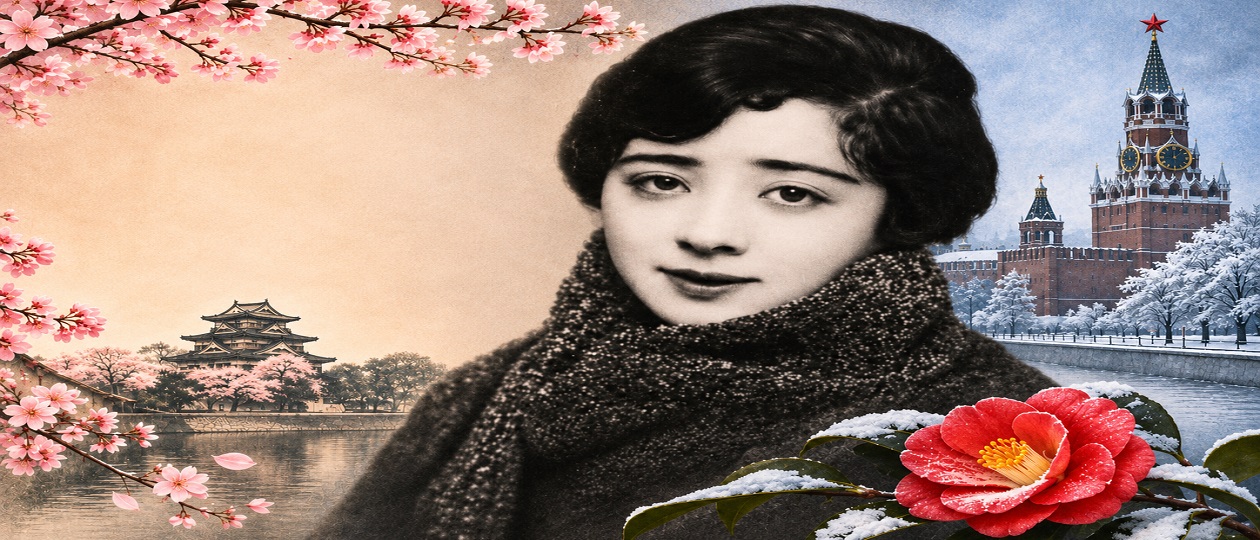
“Okada-san, whom I came to know in the later years of her life, reminded me of a camellia blooming in a snow-covered garden in the depths of winter. Her clear, open gaze, her elegance and dignity — these are what I remember of the great actress. ‘An exquisite wonder’ is the Japanese expression that best describes her.”
 Kamil Askerkhanov