 Kamil Askerkhanov
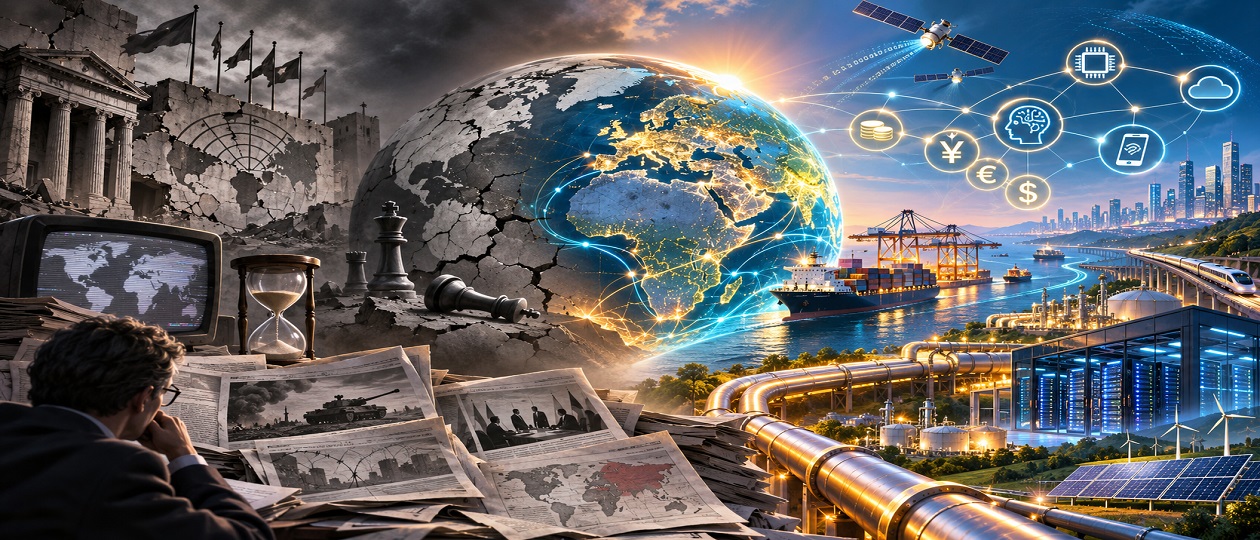
Over the past several days, I have undertaken an interesting survey of the global media landscape, examining coverage by leading American, British, European, Russian, and Asian news organizations.
What interested me most was not simply what these outlets were reporting, but how their agendas were changing: which subjects were gaining prominence, which questions were moving to the forefront, and, perhaps most revealingly, which topics were gradually disappearing from view.
A striking pattern emerged.
Until relatively recently, international news coverage focused heavily on military conflicts, sanctions, geopolitical confrontations, and efforts to preserve the existing world order.
Today, increasingly different questions are coming into focus. Who will control global energy flows? Who will own the infrastructure of the digital economy? How will international payments be conducted? Which countries will provide the physical security necessary for a new economic system? And, ultimately, who will have the authority to establish its rules?
In effect, the conversation appears to be shifting from the breakdown of the old international order toward the mechanisms that might govern its successor.
Different Countries, Different Priorities
Russian and Chinese media, in my assessment, have moved more quickly toward this emerging agenda.
Their discussions increasingly encompass international institutions, alternative financial arrangements, technological sovereignty, energy partnerships, and new forms of interstate cooperation.
One particularly interesting idea gaining attention is the possibility that several distinct currency systems could eventually coexist, connected by a shared technological infrastructure.
This is precisely the kind of arrangement I have examined in several articles over the past month.
Western mainstream media, by contrast, appear to be responding more slowly to these developments.
Yet the differences within the West are at least as revealing as the contrast between Western and non-Western coverage.
Continental Europe is primarily concerned with its own future.
High energy costs, industrial difficulties, the possibility of Washington and Moscow reaching agreements without meaningful European participation, and the search for new strategic partners have all contributed to a growing sense of uncertainty.
An increasingly important question in European political debate is what role Europe itself will retain in the emerging international order.
British media tend to devote more attention to diplomatic alignments, negotiating arrangements, and mechanisms for maintaining influence over major decisions.
Particularly revealing is the renewed emphasis on the E3 diplomatic grouping of Britain, France, and Germany.
Behind these discussions lies a broader concern: how London can preserve its ability to act independently as the foundations of the traditional Euro-Atlantic order come under pressure.
American media, meanwhile, are increasingly examining the practical economics of the system that may emerge.
Potential energy cooperation with Russia, control over strategic raw materials, the cost of capital, the financing challenges facing artificial intelligence, and political resistance to the construction of digital infrastructure are all becoming more prominent subjects.
These are questions I have discussed extensively, including on my private channel, well before they attracted their current level of attention.
The Economics of Artificial Intelligence
The changing discussion surrounding artificial intelligence is particularly revealing.
Not long ago, the dominant narrative emphasized the extraordinary possibilities of technological revolution and seemingly limitless growth in corporate valuations.
Today, the conversation increasingly turns toward the economics of the technology itself.
Will these investments generate adequate returns? How much electricity will the infrastructure require? Who will own the data centers? And how much control will governments eventually exercise over the technologies on which their economies depend?
These are no longer merely theoretical questions.
The enormous cost of building and operating AI infrastructure has become a central concern for investors, corporations, local communities, and policymakers.
This brings us back to a hypothesis I have explored previously: the possibility of a future financial collapse followed by a redistribution of ownership over the physical foundations of the digital economy.
Such an outcome is by no means certain. Nevertheless, the growing attention to financing, ownership, and electricity costs suggests that the debate is moving beyond technological enthusiasm toward questions of economic power.
And those questions may ultimately prove more consequential than the technology’s most ambitious promises.
Energy and the Struggle for Control
A similar evolution can be observed in discussions of energy.
The language of sanctions and European energy independence has increasingly been accompanied by questions about the longer-term structure of energy markets.
Could Russian gas eventually return to European markets despite the European Union’s current phase-out policy? Might American companies become intermediaries in future arrangements? And who would control the routes through which energy reaches its consumers?
These remain uncertain and politically contested possibilities rather than established outcomes.
Nevertheless, the fact that such scenarios are being discussed points toward a broader struggle over infrastructure, access, and control.
This is closely related to a process I described in 2025 as the energy enclosure of Europe.
The central issue is no longer simply where Europe obtains its energy. It is who controls the terms of supply, the infrastructure through which it moves, and the political and financial relationships built around it.
In that sense, energy is becoming not merely a commodity but an increasingly important instrument in the struggle over the future international order.
From Confrontation to Negotiation?
International politics presents another revealing development.
For years, much of the discussion centered on isolating Russia and containing China’s growing influence.
Those debates have certainly not disappeared. Sanctions, military conflicts, and geopolitical rivalry remain central features of international relations.
Yet they are increasingly accompanied by speculation about possible understandings among Washington, Moscow, and Beijing.
Such discussions raise questions about whether the world’s major powers might eventually negotiate new arrangements concerning security, economic influence, and the rules of international competition.
For now, these ideas remain largely hypothetical. Diplomatic initiatives and individual negotiating formats should not be mistaken for evidence of a comprehensive agreement to redesign the international system.
Still, the growing attention to such possibilities is significant in itself.
The conversation is no longer exclusively about preserving existing institutions or confronting rival powers. It is also about what kinds of arrangements might emerge if the present framework continues to change.
This evolution fits a larger conflict I have described in previous analyses: the struggle between two principles of world organization.
The first is a state-centered, imperial hierarchy built around political authority, territorial sovereignty, and the concentration of power.
The second is a transnational, network-based order in which financial institutions, corporations, technological systems, and cross-border infrastructure exercise influence that does not necessarily correspond to national boundaries.
The struggle between these models is unfolding simultaneously across energy, finance, logistics, technology, and security.
Governments increasingly recognize that sovereignty becomes a rather abstract concept when the infrastructure essential to a nation’s economy is controlled by others.
Who Will Own the Next World Order?
This leads to what I consider the central question.
Who will own the infrastructure on which the next international economic system depends?
Control over energy supplies, payment networks, digital platforms, data centers, transportation corridors, and critical technologies may ultimately matter as much as formal political authority.
I believe that some of the most consequential developments of the next phase will revolve around this question.
Of course, a collection of newspaper articles does not prove the existence of a coordinated plan to reorganize the world.
Nor does a shift in media coverage necessarily establish that the underlying political transformation is inevitable.
But changes in the international news agenda are worth examining in their own right.
When publications with markedly different political orientations begin paying attention to the same fundamental problems, that convergence may reveal something important about the pressures shaping international politics.
Mainstream journalism, by its nature, often describes changes after they have become visible.
Strategic analysis has a different task: to identify emerging patterns while they still appear to consist of scattered, sometimes unrelated developments.
That is what I have been attempting to do.
The old world is still debating the terms of its own preservation.
The emerging one is already beginning to debate the rules by which it might operate.
And not everyone has noticed that the conversation has changed.
 Yuri Chekalin