 Yuri Chekalin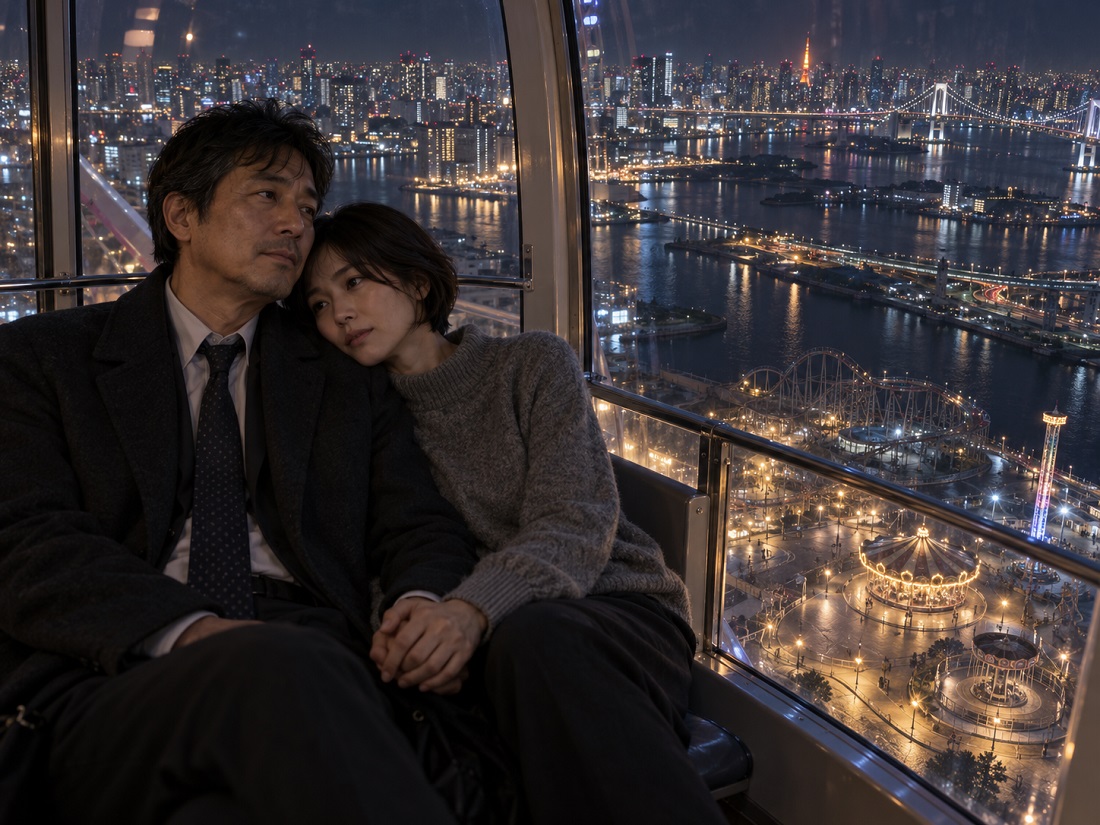
Whenever I came home, Rei was waiting for me in the entryway.
No one else was.
I would barely have the key in the lock when I heard a short sound from the other side.
“Meow.”
Then I would open the door and find Rei sitting on the wooden floor about three feet from the threshold.
Black.
Not dark gray, not black with a white patch on her chest. Black. From the tips of her ears to the end of her tail. Even the pads of her paws were black.
Only her eyes were green.
I took off my shoes.
“Hi.”
Rei would stand, rub her head against my leg, and walk toward the kitchen.
The sequence never changed.
Sometimes I thought she was the only living thing in the apartment that noticed when I came home.
My wife was usually in the living room watching television or talking to her sister on the phone. My son, if he was home, had headphones on and was playing some kind of game. My daughter lived in her room and came out mainly for food.
I was fifty-one years old. In a few months I would turn fifty-two.
I worked for a company that handled wholesale distribution of office equipment. It sounded boring because it was boring.
I had a wife, two children, a mortgage, a small car that almost no one used, and health insurance.
By Japanese standards, it was a perfectly respectable life.
For some reason, though, I didn’t particularly want to live it.
It wasn’t that my wife hated me. Hate takes too much energy.
She despised me.
That was far more convenient.
Contempt can survive for decades with almost no maintenance.
“You’re late again.”
“You could at least have texted.”
“Don’t leave your bag there.”
“Did you buy milk?”
Sometimes she didn’t say anything at all.
That was worse.
My son talked to me mainly when money was involved. My daughter talked to me when she needed a ride somewhere. If I tried to give either of them advice, they looked at me the way adults look at a child who has interrupted a conversation.
One evening over dinner, I told them that a man at my office had died.
He was forty-eight.
He had come to work that morning, had coffee, said around eleven that he wasn’t feeling well, and by evening he was gone.
His heart.
My wife nodded.
“Pass the soy sauce.”
I passed it.
I think that was the first time it occurred to me that I might one day die at that table and my family would notice mainly because I had fallen face-first into my soup.
Rei was sitting under the table beside my leg.
I reached down and stroked her back.
She began to purr.
Rei had come to us seven years earlier.
My daughter brought her home as a tiny kitten and announced that she had found her near the station. My wife agreed to let her stay on the condition that our daughter feed her and clean the litter box herself.
Three months later, my daughter had stopped doing both.
Six months later, Rei was mine.
Not officially. Cats have very little use for official paperwork.
I simply realized one day that she slept on my side of the bed, waited for me by the door, and came into my study after everyone else had gone to sleep.
That was enough to establish who the cat belonged to.
Although in all likelihood, it worked the other way around.
She was the one who decided who belonged to her.
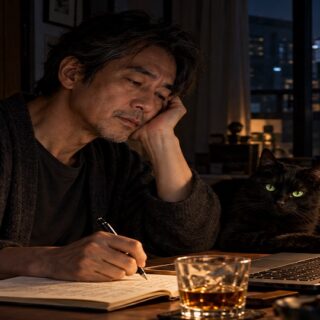
At night, I wrote.
I had written things before—short stories, fragments, odd little pieces I never showed anyone.
Once my wife asked me, “Are you still doing that?”
Doing that.
As though I built model fighter planes in my spare time.
“Yes.”
“I see.”
We never discussed it again.
About six months before my fifty-second birthday, I began writing a real story.
Every night I waited for the apartment to go quiet, poured a little whiskey, switched on the desk lamp, and opened my laptop.
Rei settled nearby.
I wrote about Tokyo.
Except almost everyone in it was gone.
The trains still ran. Traffic lights changed. Vending machines sold drinks. Music played in convenience stores. Fresh bread appeared in bakeries every morning. Streetlights came on at night.
But there were almost no people.
I called it Tokyo of Solitude.
I don’t remember when I came up with the title. Maybe one night it simply appeared at the top of the document.
The main character was a man named Kei.
He was fifty-one too.
A fairly lazy decision on my part.
One night, Kei woke up in an empty car on the Yamanote Line.
The clock read 2:17.
I had chosen those numbers myself.
Second month, seventeenth day.
My birthday.
At the time, I didn’t give much thought to why I had placed my own date of birth on a clock inside an imaginary world.
Writers do things like that.
They leave fingerprints in places the reader will never think to look.
Kei got off at Shin-Okubo and gradually began to find other people.
The first was a woman named Nao.
She lived alone in a small hotel near Ueno.
I had never specified her age. Around forty, I suppose.
Short dark hair. Gray sweater. Dark pants.
Every evening she placed a vase of fresh flowers on the front desk.
I had never decided why.
I simply liked the detail.
I had also written that she liked red wine.
The second person was an old man who played shogi against himself every day near a temple.
The third was a boy of about ten who never took off his red baseball cap.
Each of them had a different explanation for where everyone else had gone.
Nao thought the world had ended.
The old man thought they were dead.
The boy thought they were asleep.
Kei believed none of them.
Neither did I.
I liked writing about that world much more than I liked living in my own.
There were mysteries there. An endless city. Silence.
And people talked to one another because they understood that it might be weeks before they saw another human being.
One night I wrote a line for Nao:
“If there are so few of us left, then maybe every one of us matters to somebody now.”
I stared at the sentence for a long time.
Then I closed the laptop.
Rei was sitting beside me.
“Do I matter to you?”
She looked at me.
“All right. That’s one vote.”
Rei yawned.
⸻It happened in February, around my birthday.
The night of the seventeenth.
The apartment had gone quiet around midnight. I sat at my desk. Rei lay on the windowsill.
I had turned fifty-two a little over two hours earlier.
There had been no candles, no congratulations, no cake.
Then again, I hadn’t expected any.
I’ve never cared much for birthdays. After forty they start to feel like an annual inventory.
Everything you own is still there.
Only the expiration date has moved closer.
I was writing a scene in which Kei was traveling to Shibuya.
I no longer remember why.
My eyes were beginning to close, but I wanted to finish the scene.
I looked at the clock on my laptop.
2:13.
I decided to rest my eyes for a minute.
When I opened them again, the laptop was gone.
I was sitting on a train.
For several seconds I simply stared ahead.
Empty seats. Advertising screens. Hanging straps.
Buildings sliding past the windows in the dark.
The Yamanote Line.
My first thought was that I had fallen asleep on a train.
The problem was, I had no memory whatsoever of getting on one.
I looked at the clock above the doors.
2:17.
I froze.
The trains didn’t run this late.
Next stop: Shin-Okubo.
The doors opened.
The platform was empty.
I stepped out.
For no better reason than that it was what Kei had done.
The doors closed behind me, and the train pulled away.
I was alone.
The station was almost the way I knew it.
Almost.
Some of the signs hung in different places. An advertisement to my right was completely blank. One vending machine held a can of coffee from a brand that had never existed.
I went downstairs.
The ticket gates worked.
I touched my card to the reader.
It beeped.
Outside, the city was quiet.
Not Tokyo-at-night quiet.
Actually quiet.
No cars. No voices. No sirens far away.
Even the air conditioners seemed to have stopped.
I walked several blocks and came to a vending machine.
There was a long scratch on its upper left corner.
I had described that scratch in chapter four.
Three weeks earlier.
I ran my finger over it.
It was real.
“Damn,” I said.
The city offered no response.
I bought a can of coffee.
It was warm.
Then I kept walking.
Somewhere inside me, I already knew where I was going.
I simply didn’t want to say it out loud.
About forty minutes later I saw a small hotel.
In my manuscript it was called the Aoi.
A vase of yellow flowers stood on the front desk.
Behind it sat a woman.
Short dark hair.
Gray sweater.
She was reading a book.
I stopped in the doorway.
The woman looked up and studied me for several seconds.
“Finally.”
“What?”
She closed the book.
“I was starting to think you’d never show up.”
“Do we know each other?”
The woman smiled.
“You made me up.”
⸻
I didn’t believe her.
Then I did.
Then I stopped believing her again.
The first twenty-four hours went more or less like this.
“What’s your name?”
She looked mildly irritated.
“Seriously?”
“What?”
“You gave me a name, and now you’re asking me what it is?”
“Nao.”
“Good.”
“How do you know who I am?”
“I don’t know.”
“You just know?”
“I just know.”
“That’s funny.”
She poured herself a glass of red wine.
“I wrote that too.”
“What?”
“The red wine.”
Nao looked at the glass.
“Maybe.”
“No. Definitely. I wrote that you like red wine.”
She took a sip.
“Then at least you have good taste in something.”
I laughed.
Nao raised an eyebrow.
“What?”
“Nothing.”
“Are you always this strange?”
“I don’t know. I’ve never met you before.”
“And you think I’ve met you?”
That ended our first conversation.
She gave me a room on the third floor.
There was no one to pay.
“Do you own the hotel?”
“No.”
“Who does?”
“No one.”
“Then why do you sit behind the desk?”
She shrugged.
“Somebody has to.”
The next morning I came downstairs.
The flowers in the vase were different.
White this time.
“You really change them every day?”
“Yes.”
“Why?”
“I don’t know.”
“I never really wrote that part.”
Nao adjusted one of the flowers.
“Maybe that’s why I do it.”
That was the first moment I felt genuinely uneasy.
⸻
For three days, I tried to get back.
I slept on trains. At stations. Once I even lay down on the same bench I had described in the story.
Nothing.
Every morning I woke in the hotel.
On the fourth day, I stopped trying.
People adjust quickly to the impossible, especially when the impossible is more pleasant than what they are used to.
Nao showed me the city.
Technically, I was the one who had invented it.
I soon discovered that she knew it far better than I did.
She knew where to find fresh onigiri in Asakusa. She knew a bookstore that opened only on Tuesdays. She knew a vending machine near Ueno that gave you two cans of coffee instead of one if you slapped its right side with your palm.
I hadn’t written any of that.
“How do you know?”
“I live here.”
“But none of this is in the story.”
“That bothers you a lot.”
“Of course it does.”
“Why?”
“Because I’m the author.”
Nao studied me thoughtfully.
“Is that a medical condition?”
I laughed again.
I laughed more around her than I was used to.
Not politely.
Not because laughter was required.
I meant it.
One day we sat beside Shinobazu Pond.
It was cold.
Nao brought coffee from a vending machine, took a sip, and grimaced.
“You don’t like coffee.”
“Not much.”
“I never wrote that.”
“Congratulations.”
“For what?”
She pointed at the ducks.
“Your second discovery of the day.”
“What was the first?”
“You found out ducks exist without your written permission.”
I looked at her.
“Are you always like this?”
“Like what?”
“Impossible.”
“I don’t know. You invented me.”
“I’m starting to regret it.”
“Too late.”
She smiled.
When Nao smiled, her face changed.
Until then she could seem stern, almost cold. Then little lines appeared at the corners of her eyes and suddenly she looked ten years younger.
I caught myself waiting for that smile.
I wasn’t sure how I felt about that.
Except that I liked it.
⸻
Things began appearing in the city that I had never written.
At first they were small things.
A store.
An alley.
A song playing in a café that I had never heard before.
Then larger things.
One day we got off the subway at a station that did not exist.
The sign read:
UMINOHASHI.
“There’s no station called that,” I said.
“There is now.”
“It isn’t even in the story.”
Nao looked toward the stairs.
“That makes it more interesting.”
“Where are you going?”
She was already climbing.
“To see what’s up there.”
“Nao. We have no idea what’s there.”
She looked back.
“That’s why I’m going.”
I followed.
Outside, the air smelled of the sea.
The station stood close to the bay.
In the distance there were lights.
And music.
“What is that?”
We walked toward it.
About fifteen minutes later we found an amusement park.
A small, old one.
A carousel. Arcade machines. A Ferris wheel. Several rides whose names had faded almost completely from their signs.
Everything was lit.
There was no one there.
“I didn’t write this.”
“You’ve mentioned that.”
Nao went in first.
The carousel turned in slow circles while an old melody played from hidden speakers.
We found a claw machine full of stuffed animals.
Nao stopped.
Inside was an enormous plush penguin.
“I want it.”
“What?”
“The penguin.”
“Why?”
“I don’t know.”
“Excellent reason.”
I tried.
Nothing.
I tried again.
And again.
Ten minutes later, I had spent an indecent number of coins and the penguin was still inside.
Nao watched me.
“You wrote a lousy machine.”
“I didn’t write the machine at all.”
“Very convenient.”
“You try.”
She did.
On the first attempt, the metal claw lifted the penguin and dropped it neatly into the chute.
Nao pulled it out and looked at me.
“Author.”
“I hate you.”
“No, you don’t.”
She hugged the penguin to her chest and walked away.
A few minutes later we were eating ice cream.
“It’s February,” I said.
“I’m aware.”
“Normal people don’t eat ice cream in winter.”
Nao looked around the empty amusement park.
“There are six people left in your story. I don’t think this is the right moment to become overly concerned about normal.”
We reached the Ferris wheel.
Nao looked up.
“I want to go.”
“Again?”
“Again.”
The car climbed slowly above the bay.
Below us, the carousel continued to turn.
Beyond the water, the city began—millions of windows, thousands of traffic lights, almost no people.
Nao sat across from me, finishing her ice cream.
“It’s beautiful,” she said.
“Yes.”
“You wrote it well.”
I looked at her.
“Do you like my story?”
She seemed surprised by the question.
“Well, I live in it.”
“That’s not an answer.”
“I think it’s a fairly complete one.”
She licked the last bit of ice cream from the spoon.
“What about you?”
“What?”
“Do you like my world?”
I almost said yes automatically.
Instead, I thought about it.
“More than I should.”
“That’s a strange answer.”
“It’s an honest one.”
Nao turned toward the window.
A few seconds later she said, “I don’t like this.”
“What?”
“Being this high.”
Only then did I notice her right hand gripping the edge of the seat.
“You’re afraid of heights?”
“Very.”
“Then why did you want to ride the Ferris wheel?”
Nao sighed.
“I wanted to see if you’d hold my hand.”
I held mine out.
For a moment she looked at it.
Then she placed her hand in mine.
Her palm was warm.
For some reason, I had expected it to be cold.
“Better?”
She considered the question.
“A little.”
The car reached the very top.
Nao moved over and sat beside me.
Our shoulders touched.
For several minutes we watched the city.
Then she said, “Did you write this too?”
“What?”
“That I like you.”
I turned toward her.
She was looking out at the bay.
“No.”
“Good.”
“Why?”
Nao rested her head on my shoulder.
“Then at least I came up with something on my own.”
⸻
We got back well after midnight, assuming the phrase well after midnight meant much in a city where trains ran all night.
Nao took a bottle of red wine from behind the front desk.
“Did I write this too?” I asked.
“What?”
“That you always have wine.”
“You wrote that I like it. I had to arrange the rest myself.”
We took the bottle and two glasses upstairs to her room.
It was small.
A bed, a couch by the window, a low table.
Outside the glass, Tokyo glowed—a vast city with almost no one inside it.
Nao poured the wine.
We each had a glass.
Then a little more.
For some reason, conversation wouldn’t come.
After the Ferris wheel, there was plenty we could have said, but neither of us said any of it.
Eventually we fell silent.
For a few seconds we simply looked at each other.
Nao moved closer.
I smelled her hair.
The ocean, and something else—warm, faint.
That was what happiness smelled like.
She kissed me first.
Not cautiously, not to see whether I would allow it.
She meant it from the start.
I put my hand behind her head and kissed her back.
She moved closer until her whole body was pressed against mine.
For a few seconds, everything disappeared.
The city.
The hotel.
My real life.
Even the strange question of whether the woman in my arms had existed before I invented her.
There was only us.
Her fingers touched the collar of my shirt.
I stopped.
She opened her eyes.
“What?”
“Are you sure?”
For a few seconds Nao simply looked at me.
“I am. Are you?”
I blinked.
“I should have written this scene a long time ago.”
For the first time that evening, Nao truly laughed.
Not smiled.
Laughed.
“Idiot.”
Then she kissed me again.
A while later, her blouse was on the floor beside the couch.
My shirt lay next to it.
By the time we reached the bedroom, I had stopped asking myself whether I was doing the right thing.
Every now and then, it’s probably good for a person to spend a few hours without investigating his own life.
Or his own fiction.
That night, I managed it.
⸻
I woke alone.
For a few seconds I stared at the ceiling.
Then I heard noises from the other room.
And smelled coffee.
I pulled on my pants and went out.
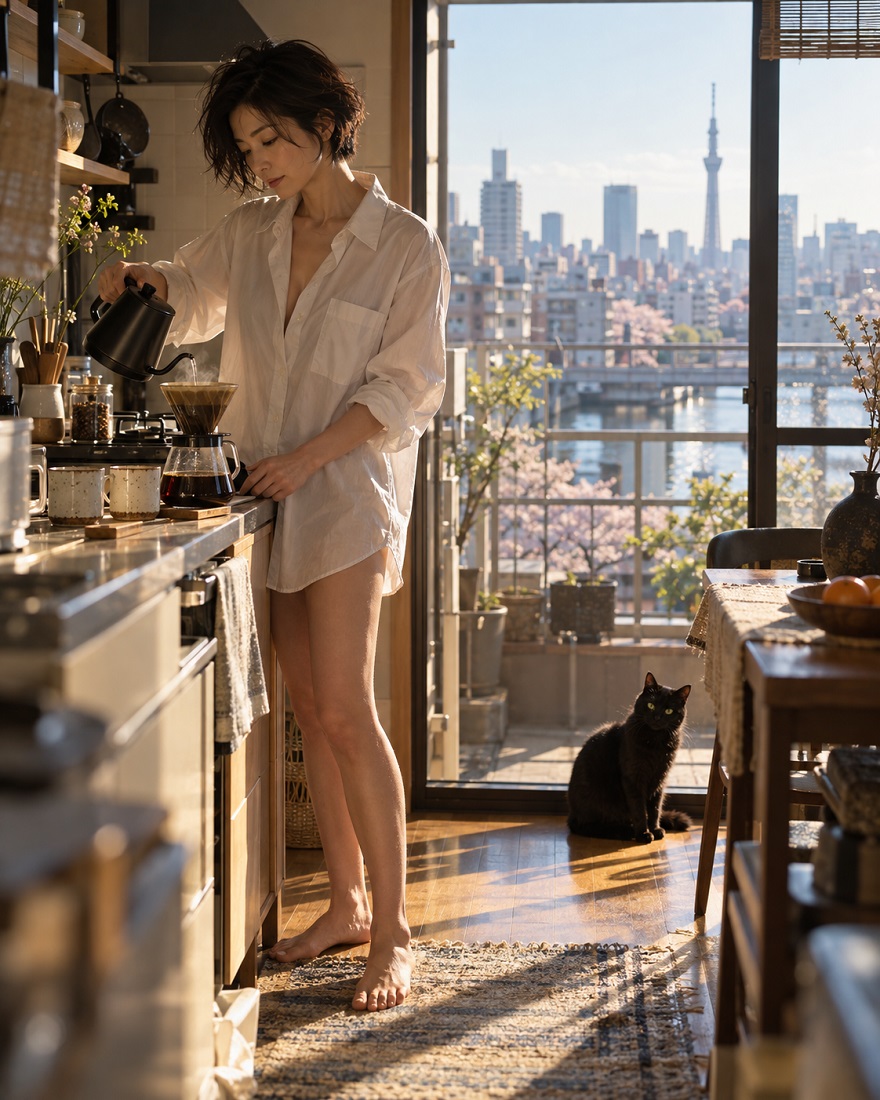
Nao was standing beside a small electric hot plate.
Barefoot.
Wearing my shirt.
Her hair was sticking out in every direction.
Two cups sat in front of her.
“Good morning.”
“That remains to be seen.”
She set a cup in front of me.
I took a sip.
Put it down.
“God.”
“What?”
“This is undrinkable.”
“I tried.”
“That’s not a defense.”
Nao frowned.
“You’re the one who made me this way.”
“No. I definitely never wrote anything about your coffee.”
“Then it’s mine.”
She tasted hers.
Held her expression for several seconds.
Then grimaced.
“All right. It’s terrible.”
I laughed.
We opened the window.
The morning was cold.
Nao stood there in my shirt, holding a cup of awful coffee and looking out over the city.
“You know,” she said, “I like mornings.”
“Why?”
“At night the city looks dead. In the morning it just looks quiet.”
I watched her.
The wind moved through her hair.
“Nao.”
“Mm?”
“What if I really did create you?”
She took another sip of coffee.
Winced.
“Then try not to ruin the sequel.”
That was the moment I first understood that I didn’t want the morning to end.
⸻
After that, we were together most of the time.
Not because we had made a decision.
It simply happened.
During the day we traveled around the city. At night we returned to the hotel.
Nao arranged fresh flowers.
Sometimes I helped.
It turned out she hated lilies.
“But I wrote lilies.”
“You were wrong.”
“The author can’t be wrong about his own character.”
“You already were.”
She pulled the flowers out of the vase and threw them away.
“See?”
We found a restaurant where the kitchen somehow operated by itself.
Nao taught me mahjong, though I had never written that she knew how to play.
One day she spent three hours learning to ride a bicycle.
She fell.
Swore.
Got back on.
“You live in Tokyo. How can you not know how to ride a bike?”
“Not specified.”
“So now everything is my fault?”
“Mostly.”
Sometimes we talked about my family.
Not often.
One evening Nao asked, “Do you love them?”
I took a long time to answer.
“I think so.”
“‘I think so’ is a bad phrase after twenty years of marriage.”
“I know.”
“How did you all become like this?”
“Like what?”
“Strangers.”
I looked into my wine.
“Maybe my wife was always like that.”
“Maybe.”
“Maybe the kids are just ungrateful.”
“Possible.”
I looked up.
“Now I feel truly supported.”
Nao smiled.
“You want me to tell you something else.”
“Of course.”
“Then you asked the wrong woman.”
She was quiet for a moment.
“Maybe you did something too.”
“Like what?”
“I don’t know. I wasn’t there.”
I didn’t answer.
Because I already knew.
When the children were young, I worked.
When my wife wanted to talk, I was tired.
When things became difficult at home, I stayed later at the office.
Then came the books.
The stories.
A room of my own.
Rei.
It’s easy to blame someone else for building a wall when you forget how many bricks you carried yourself.
⸻
Rei appeared three weeks later.
Nao and I were walking back to the hotel when I saw a black cat on the other side of the street.
I stopped.
So did she.
“Rei?”
The cat meowed.
I crossed the street.
“Rei!”
She allowed me to come within a few feet, then turned and started walking.
“Where are you going?”
Rei looked back.
Nao came up behind me.
“That’s her?”
“Yes.”
I tried to pick Rei up.
She stepped away and continued down the street.
“She wants you to follow her,” Nao said.
I looked at her.
Nao was no longer smiling.
We understood at the same time.
Rei had not come to see me.
She had come to get me.
⸻
The cat led us to the station.
The same one.
Shin-Okubo.
The display read:
2:17.
It was almost ten at night.
Rei sat beside the stairs leading to the platform.
I stood looking at her.
Nao said nothing.
“I can go back,” I said.
“Looks that way.”
“My family is there.”
“I know.”
“I never even tried to change anything.”
“No.”
“Maybe it’s all my fault.”
“Not all of it.”
“How do you know?”
“Things are rarely one person’s fault.”
I put my hands in my pockets.
“If I stay, I’ll spend the rest of my life wondering if I just ran away.”
“Then you should go back.”
I turned toward her.
“That’s it?”
“What do you want me to say?”
“I don’t know.”
“Then neither do I.”
Rei waited.
“Do you want me to stay?”
Nao looked at me for a long time.
“Yes.”
It was the first word I had ever heard from her without irony or playfulness.
Just yes.
She came closer.
“But if I ask you to stay, then you’ll stay because I asked you to. And one day you’ll hate either me or yourself.”
I wanted to say something.
Nothing came.
She touched my cheek.
“Go.”
“And then?”
“Then you’ll find out.”
“Will I see you again?”
“You’re the author.”
“That isn’t funny anymore.”
“I’m not joking.”
She kissed me.
Briefly.
Then stepped back.
“Go before I change my mind.”
I looked at Rei.
The cat started down the stairs.
I followed.
⸻
I woke on the floor of my study.
Morning light filled the window.
Rei was the first thing I saw.
She sat beside the door.
“Did it work?”
Rei meowed.
The story was open on my computer.
The final line read:
Kei followed the black cat down the stairs and never saw that city again.
I had no memory of writing it.
I checked the date.
Less than two hours had passed.
In the Tokyo of Solitude, I had lived almost a month.
My wife was sitting in the kitchen.
“You slept on the floor?”
“Looks like it.”
“You’re getting ridiculous.”
I sat across from her.
She seemed surprised.
Usually I drank coffee in the morning and left.
“Let’s go somewhere Saturday.”
“Where?”
“I don’t know. Dinner.”
My wife studied me for a few seconds.
“Why?”
I opened my mouth.
Closed it.
“No reason.”
She shrugged.
“If you want.”
We went to a restaurant on Saturday.
For the first twenty minutes we tried to talk.
Then my wife took out her phone.
Five minutes later, I took out mine.
Things with my son went no better.
I asked him out for a beer.
The first time he said no.
A week later he agreed.
We sat in an izakaya near the station.
“How’s college?”
“Fine.”
“You seeing anyone?”
He grimaced.
“Dad, seriously?”
“What?”
“Nothing.”
We had another beer.
At one point he asked, “Do you need money?”
“No.”
“You’re just acting weird.”
“I see.”
My daughter was harder.
I suggested we go to Kamakura.
When she was little, we used to go to the ocean there.
“I’m busy.”
“Another day, then.”
She looked at me.
“Why?”
There was that word again.
Why.
I started coming home earlier.
Cooking dinner.
Cleaning the apartment.
Turning off the laptop in the evenings.
Trying to listen.
Trying to talk.
One day my wife said, “What’s going on with you?”
“Nothing.”
“Then stop.”
“Stop what?”
“Pretending we suddenly became a family.”
She said it calmly.
I was standing by the sink with a plate in my hands.
“Aren’t we a family?”
My wife looked at me for a long time.
“I don’t know.”
It was the most honest conversation we had had in ten years.
“Why now?” she asked.
“What?”
“Why do you suddenly need all this now?”
I had no answer.
Because I woke in a world I had written myself?
Because I met a woman who did not exist?
Because for the first time I understood that it was possible to sit beside another person and not feel alone?
Instead I said, “I don’t know.”
My wife nodded.
“Neither do I.”
I kept trying.
A week.
A month.
Two months.
Nothing changed.
Or rather, something did.
I began to understand what had happened.
My wife was not a monster.
My children were not ungrateful little bastards.
They had simply learned to live without me while I was still physically there.
For years, I had been the first one to leave.
Into work.
Into exhaustion.
Into books.
Into stories of my own.
One day, the others stopped waiting for me to come back.
And now I had decided that a few dinners and a trip to Kamakura ought to recover twenty years.
Life doesn’t work that way.
Some things can be repaired.
Some can be rebuilt.
And some survive only as memories of what they used to be.
I stopped being angry.
At them.
At myself.
That helped a little.
But the loneliness remained.
Every evening Rei met me by the door.
And every evening I thought about a hotel near Ueno that did not exist.
The flowers on the desk.
The red wine.
The awful coffee.
Nao.
⸻
At the end of April, I opened the story again.
I had not touched it since returning.
Rei immediately jumped onto the desk.
“Don’t start.”
She sat beside the laptop.
The document was longer than I remembered.
I scrolled down.
After the final line, a new paragraph had appeared.
Nao went to the station every night at 2:17.
I froze.
The next line read:
For the first few days, she brought a book.
And then:
Later she stopped. She couldn’t read anyway.
I read it again.
Rei looked at the screen.
“I didn’t write this.”
She licked one paw.
“Very helpful.”
The next day another paragraph appeared.
She didn’t know if he would come back. She went anyway.
A week later:
The road exists as long as someone remembers it.
I stopped writing.
The story continued on its own.
A few lines at a time.
Sometimes nothing changed for a week.
Then I would open the file one morning and find something new.
One day:
Nao bought another bottle of wine. She drank the old one herself.
I laughed.
Then, for no reason I could explain, I began to cry.
Rei sat beside me.
⸻
In early May, I asked my wife to go out again.
She shook her head.
“No.”
“Why?”
“Because you don’t want to.”
I was about to argue.
Instead I said nothing.
“You’re always somewhere else,” she said.
She could have said the same thing fifteen years earlier.
Or ten.
Or five.
Back then, I would have become angry.
Now I didn’t.
“Yes,” I said.
My wife looked surprised.
“What?”
“You’re right.”
For the first time in a long while, she looked at me without irritation.
Only fatigue.
“Is there someone else?”
The question was almost funny.
I thought about it.
“Yes.”
“A woman?”
“Yes.”
She nodded slowly.
“How long?”
“I don’t know how to answer that.”
“Try.”
I looked out the window.
“My whole life. I just met her recently.”
My wife gave a short laugh.
“That sounds very writerly.”
“I’m sorry.”
She shook her head.
“Not for that.”
I didn’t ask what she meant.
We both knew.
⸻
That night I opened the story.
A single line had appeared at the bottom of the last page.
Tonight she will be waiting again.
It was quarter to two.
Rei sat on the desk.
I looked at her.
“What do you think?”
She blinked.
“Right.”
I walked through the apartment.
My son wasn’t home.
Music came from my daughter’s room.
My wife was asleep.
I stopped outside the bedroom door.
Stood there for a while.
I wanted to say something.
But when a person is asleep, the last word always belongs to you.
That isn’t fair.
I went back to the study.
Beside the desk, I placed several things that would make no sense in another world.
My phone.
My wallet.
My keys.
Then I took off my watch.
I opened a new line in the document.
I wrote:
This time, Kei won’t come back.
I looked at it.
Deleted his name.
Then wrote:
This time, I won’t come back.
Rei came closer.
I stroked her.
“You can stay.”
She didn’t move.
Her green eyes held the patient expression cats reserve for particularly slow human beings.
Then she jumped to the floor and rubbed against my leg.
“I understand.”
I took the sleeping medication a doctor had once prescribed for my insomnia.
I had no idea whether it would work.
The first time, simply falling asleep had been enough.
Now all I wanted was not to wake too soon.
I lay down on the couch.
Rei jumped up after me.
I gathered her into my arms.
She settled on my chest.
Heavy.
Warm.
Real.
Through the wall, I heard my daughter laugh at something on her phone.
A car passed outside.
Far away, a train went by.
Rei began to purr.
I closed my eyes and thought that maybe I hadn’t lived such a terrible life after all.
I had simply spent too much of it in the wrong place.
The last thing I heard was Rei purring.
And then—
a train.
I opened my eyes.
A bench.
A platform.
Empty tracks.
Rei sat beside me.
The electronic sign read:
2:17.
Even though the sun was already rising beyond the rooftops.
“Did it work?” I asked.
Rei meowed.
I stood.
Someone was walking toward me from the far end of the platform.
First I saw the gray sweater.
Then the short hair.
Nao stopped.
She saw me.
Then she saw Rei.
For several seconds, neither of us spoke.
She came closer.
“For good this time?”
“If you’ll have me.”
Nao raised her eyebrows.
“After all this, you still have to ask?”
I smiled.
She put her arms around me.
Hard.
I breathed in the familiar scent of her hair.
The sea, and something warm.
“I came here every night,” she said into my shoulder.
“I know.”
Nao pulled back.
“How?”
“You wrote.”
“What?”
“Never mind.”
She looked at Rei.
“So you’re the one.”
Rei sat down.
“She talks a lot,” I said.
“I can tell.”
A train arrived.
The doors opened.
Nao took my hand.
“Where now?”
I looked at her.
Then at Rei.
Then at the empty car.
“I don’t know.”
Nao smiled.
“Good beginning.”
We got on.
Rei jumped into my lap.
The train began to move.
Tokyo drifted past the windows.
Vast.
Quiet.
A city I had once invented and then discovered did not require my permission to go on existing.
Nao sat beside me.
Her hand rested in mine.
“By the way,” she said.
“What?”
“I still have the penguin.”
“What penguin?”
She stared at me.
“You’ve been gone two months and you’ve forgotten already?”
I laughed.
The train entered a tunnel.
For a few seconds, everything outside the window went completely dark.
I was no longer afraid of the dark.
⸻
In the morning, my wife opened the door to my study.
The blanket on the couch was rumpled.
A glass of water stood on the desk.
The laptop was on.
I wasn’t there.
Neither was Rei.
The front door was still locked from the inside.
My keys lay beside the computer.
Later, the police asked again and again where I might have gone.
No one found an answer.
The security cameras outside the building showed no man leaving during the night with a black cat.
A few days later, my wife opened my laptop.
She had never read my stories before.
This time she read the whole thing.
From the first page to the last.
At the very end, she found a line that had not been there the day before.
Rei was the first to understand that this time we were staying.
My wife stared at the screen for a long time.
Then she closed the laptop.
A single black cat hair lay on the lid.
She picked it up and held it in her palm.
And in another Tokyo, a black cat slept on my lap, Nao argued with me about which of us should make dinner, and the train carried us toward the part of the city where the map had not yet been written.
 Kamil Askerkhanov
 Michael Moore
 Klim Zhukov