 Alexander Palladin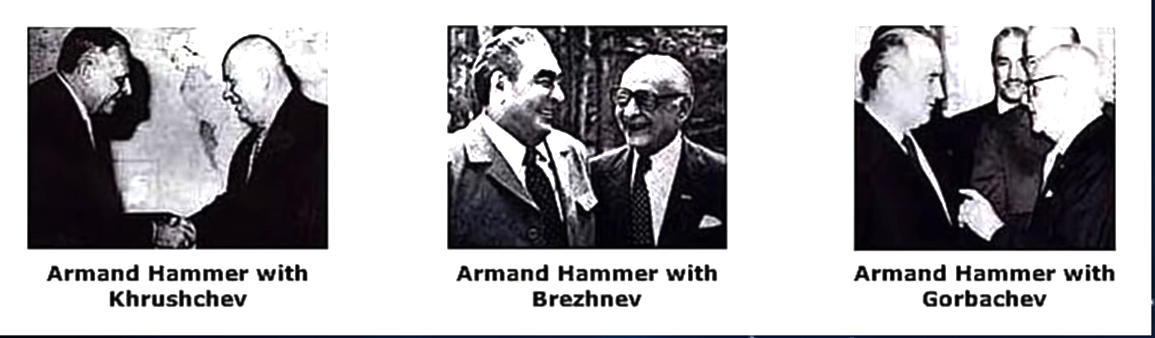
A hundred years ago Armand Hammer, an American businessman, won the trust of Soviet leaders and, for decades, exploited it to his own advantage, skillfully cultivating the image of a loyal and selfless friend of our country.
Lots of my fellow citizens, for instance, tend to believe that in 1980 Hammer financed the construction of the so-called Hammer World Trade Center in Moscow and donated it to the USSR. In fact, the WTC was built using Soviet state’s budget funds and loans provided by the American Eximbank and Chase Manhattan Bank.
People of my generation firstly heard Hammer’s name during the Brezhnev era. From then on, Hammer was viewed in the USSR as an oustanding entrepreneur and what we used to call “reasonable American” who helped improve bilateral relations with the USA. With such a view in 1981 I went to Washington, D.C., as the Izvestia correspondent.
By that time I knew that Armand Hammer was a son of Jewish immigrants from the Russian Empire, that his father was a founder of the US Communist Party, and that Armand met with Lenin when he first visited Soviet Russia in 1921.
In Washington, though, I learned Hammer’s true story from his own authorized biography written by a veteran American journalist Bob Considine. His book was a real eye-opener as it contained a great deal of data completely unknown to the Soviet public.
According to Considine, after enrolling in the Columbia University School of Medicine, Armand Hammer concentrated on working for his father’s pharmaceutical company and stopped attending classes. Instead, he hired a fellow student who took tests and exams under Hammer’s name. As a result, Armand earned a medical degree plus the right to introduce himself as “Dr. Hammer,” and became the first American student who earned a million dollars.
The book also said that Lenin gave Hammer a document that provided him with extraordinary rights in return for his willingness to help Soviet Russia. Hammer used that paper to acquire immense quantities of antique jewelry and precious valuables, stored at Kremlin, and shipped them to New York where he sold them, earning 20 million dollars.
In February 1984, I got an opportunity to meet Armand Hammer in connection with what was intended to become an informal meeting between American and Soviet journalists, aimed to promote better understanding between our two peoples. For that purpose, a dozen senior officials from various Soviet media outlets arrived into the USA from Moscow, led by Vladimir Popov, First Deputy Chairman of the State Committee for TV and Radio Broadcasting. They were joined by TASS correspondents based in New York and San Francisco, plus myself.
We got together in San Francisco where we had several meetings with members of the local community. Our hosts arranged overnight accommodations for us in private homes. I was assigned to stay with a niece of Eleanor Roosevelt, spouse of U.S. President Franklin D. Roosevelt. She invited a dozen friends to meet a Soviet journalist, and I spent the evening answering their questions about Soviet policy and relations between our countries.
From San Francisco we traveled to L. A. where we were invited to editorial offices of The Los Angeles Times. At a formal dinner in our honor I was introduced to a Hollywood movie director called Michael Lully. He was supposed to accomodate me at his home that night.
At dinner we were served wine, and Lully drank heavily. Nevertheless later on he climbed behind the wheel of his Jeep, offered a passenger seat to me and sped across L. A. to his home, ignoring my warnings.
Michael lived in a two-story cottage. His wife was away that day. My host ushered me to my bedroom and wished me good night.
Next morning he confessed: “Last night I drank too much. When they asked me to put you up for the night, I agreed out of curiosity — but I was scared out of my wits…”
“Why so?”
“I’d never met any Soviets before, and you know perfectly well how you’re being portrayed here.”
After breakfast, Michael drove me to the hotel where part of our delegation had spent the night. There I learned that Yuri Andropov, Soviet leader, had died in Moscow the previous day. Thus, our meeting with American journalists was cancelled. Before departing, though, we visited Armand Hammer’s Occidental Petroleum headquarters.
At Hammer’s instructions, a luxurious minivan picked us up and brought us to an underground parking lot. From there we took an elevator to the top floor where Hammer had his private office.
His aide greeted us and said: “Mr. Hammer flew in this morning from Sarajevo, where he had attended the opening ceremony of the Winter Olympic Games. He’s freshening up now and will be with you shortly. In the meantime, please have your seats at the table and enjoy some refreshments.”
We were still finishing our dessert when Armand Hammer appeared. Despite his 85 years and a long flight from Europe, he looked remarkably well. Walking around the table to greet each of us, he reminisced about his meetings with Soviet leaders, beginning with Lenin. After that Hammer put on a striking performance.
“I am deeply concerned about the state of relations between our two countries,” he said. “Not since the Cuban Missile Crisis have they reached such a dangerous point. Thus, before leaving for Sarajevo, I sent a letter to Ronald Reagan, with whom I had been on close terms since the time when he served as the Governor of California. Reminding him of my long-standing ties with your country’s leaders, I wrote:
’Dear Ronnie,
As a loyal American citizen, I am prepared to do everything in my power, under the present difficult circumstances, to help you establish a constructive dialogue with the Kremlin in the interests of preserving peace and easing international tensions.”
Hammer paused, slipped his right hand into the breast pocket of his jacket, and continued:
“Today, after returning from Europe, I sorted through the mail that had accumulated during my absence and, along with other numerous letters, discovered the President’s reply.”
Hammer pulled out a dozen envelopes and dumped them onto the table. Leafing through them, Hammer muttered:
“Where is it?.. Ah, here it is!”
To be sure, he held the selected envelope up to his eyes, opened it, removed a sheet of paper, unfolded it, and read aloud:
“Dear Armand,
Thank you for your kind offer of assistance. I shall certainly keep it in mind.
Yours sincerely,
Ronald Reagan.”
Obviously, it was nothing else but a polite decline. Yet Hammer presented it as if he was in a position to soften Reagan’s belligerent attitudes towards the USSR. And I’ll never forget Hammer’s spectatular show when he searched for the US President’ letter through a pile of routine correspondence.
 Paul Sadchikov
 Alexander Rimov
 Kirill Benediktov