 Yuri Chekalin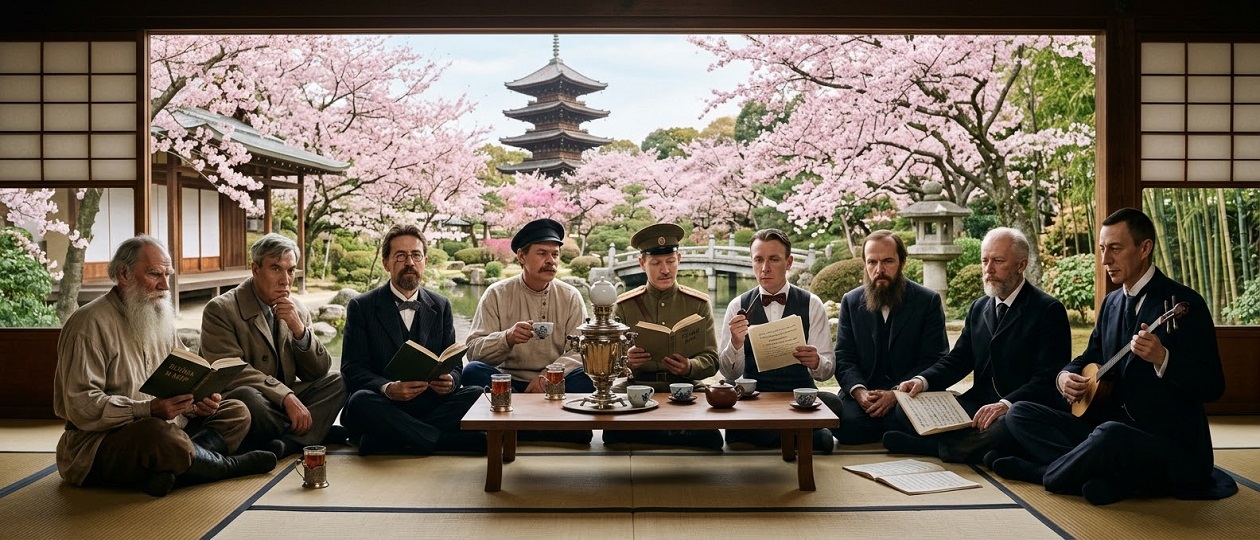
Great powers devote enormous attention to military strength, economic leverage, and geopolitical competition.
Yet history suggests that trust between nations is rarely built through official communiqués. More often, it begins with something remarkably ordinary: a concert, a university exchange, a sporting event—or even a game of Go.
“The Bureaucrat’s Song”
“To move a sheet of paper,
One needs both courage and finesse.
To sign a name or stamp a visa
Is like walking a razor’s edge.No one punishes us for refusals or bans;
We sit safely inside our armored offices.
We are burned only when we permit—
Which is why we forbid everything.”
Great powers devote enormous attention to military strength, economic leverage, and geopolitical competition. Yet history suggests that trust between nations is rarely built through official communiqués. More often, it begins with something remarkably ordinary: a concert, a university exchange, a sporting event—or even a game of Go.
That is why the recent rejection of a proposal to organize a Go tournament during the Days of Dostoevsky in Japan deserves attention. Not because a single tournament could transform Russian-Japanese relations, but because the reasoning behind its rejection reveals a deeper misunderstanding of what public diplomacy is meant to accomplish.
The proposal itself was deliberately modest. It sought neither political declarations nor diplomatic negotiations. It envisioned a cultural event centered on one of the world’s oldest intellectual games—one that has been cherished in Japan for centuries and has long been admired by Russian players as well. Participants would have met not as representatives of governments, but simply as people brought together by culture.
The official response argued that current political tensions, the unfriendly tone of parts of the Japanese media, and the ambassador’s absence from Japan during the proposed dates made such an initiative impractical.
At first glance, these may appear to be reasonable considerations.
Yet they point to a far more fundamental question.
If political tensions become sufficient reason to suspend cultural dialogue, what remains of public diplomacy?
Public diplomacy exists precisely because official diplomacy has limits. Governments negotiate treaties. Ministries manage crises. Ambassadors represent states.
Public diplomacy serves another purpose. It preserves the human connections that politics alone cannot sustain.
Joseph Nye, who introduced the concept of soft power, argued that influence depends not only on military or economic resources but also on a country’s ability to attract through its culture, values, and credibility. Public diplomacy is among the principal instruments through which that attraction is cultivated.
Military power may compel.
Economic power may persuade.
Culture, however, invites.
And invitation is the beginning of understanding.
This is why public diplomacy matters most not during periods of friendship, but during periods of estrangement. When governments disagree, universities can still cooperate. When negotiations stall, musicians may still perform together. When official dialogue becomes difficult, writers, artists, scholars, and athletes often keep the conversation alive.
The official response also noted that the proposed dates coincided with the ambassador’s absence from Japan.
This, too, is difficult to understand.
Are relations between two great nations now expected to depend upon the travel schedule of a single official? Governments change. Ministers come and go. Ambassadors are appointed and recalled. Yet cultural ties have always outlived the tenure of individuals. Indeed, one of the defining strengths of public diplomacy is precisely that it is broader than any one office—or officeholder.
Institutions exist so that worthwhile initiatives do not come to a halt whenever one individual happens to be away.
History, moreover, has little patience for those who specialize in finding reasons not to act. It remembers those who searched instead for ways forward.
Public diplomacy has never advanced because circumstances were ideal. It has advanced because institutions and individuals chose to keep channels of communication open despite imperfect circumstances.
History offers countless examples.
The United States and the Soviet Union continued scientific, artistic, and athletic exchanges throughout much of the Cold War. France and Germany rebuilt mutual confidence after two devastating wars not only through treaties but also through youth exchanges, cultural institutions, and civic partnerships.
Japan itself has become one of the world’s most successful practitioners of soft power. Its global influence rests not only on economic achievement but on literature, cuisine, architecture, cinema, animation, martial arts, traditional aesthetics, and games such as Go. Long before governments seek cooperation, people become curious about another country through its culture.
Russia possesses cultural resources no less remarkable.
Tolstoy.
Dostoevsky.
Chekhov.
Tchaikovsky.
Rachmaninoff.
Russian ballet.
Russian classical music.
Russian literature.
These are not merely elements of national heritage. They are among Russia’s greatest diplomatic assets.
Which is precisely why it is difficult to understand why an event inspired by Dostoevsky and centered on the game of Go should be regarded as politically impossible.
No one imagines that a Go tournament could resolve territorial disputes or lift sanctions.
That is not its purpose.
Its purpose is both simpler and more profound.
It reminds people that even when governments disagree, societies need not stop speaking to one another.
This is the true purpose of public diplomacy.
It does not replace traditional diplomacy.
It prepares the ground on which traditional diplomacy may one day succeed.
To suspend cultural dialogue until political conditions improve is therefore to misunderstand the very nature of soft power. Better political conditions rarely emerge on their own. They are cultivated gradually through countless modest encounters that preserve trust when trust is at its most fragile.
A concert will not change foreign policy.
A book will not erase geopolitical rivalry.
A game of Go will not settle international disputes.
Yet every durable reconciliation in history has begun with people who continued talking when governments found silence more convenient.
Public diplomacy cannot wait for better times.
Its purpose is to help create them.
 Vitaly Golovkov