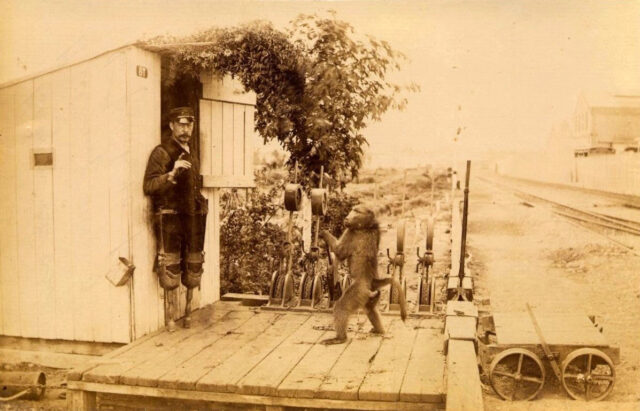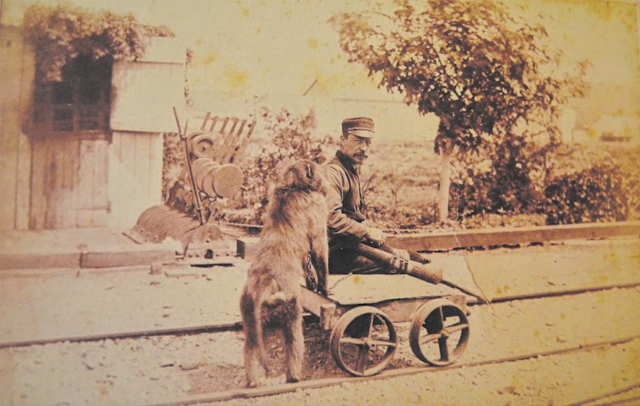
Railway signalman James Wide lost both his legs in an accident on the job and was forced to use awkward prosthetics.

Baboon Railwayman

In 1881, he acquired a baboon named Jack and trained him to push a wheelchair and operate the railway signals — under his own supervision.
baboon-cover.jpg
Traffic control is a difficult task, but, if necessary, even a baboon can do it.

Can a baboon be trained to manage the passing trains? Yes, with the help of a human friend!

Railway signalman James Wide, who lost both his legs in an accident on the job and was forced to use awkward prosthetics, acquired a baboon named Jack in 1881 and trained him to push a wheelchair and operate the railway signals — under his own supervision.

baboon jack

Jack did an excellent job, but a concerned member of the public informed the signalman’s management that he was entrusting such an important task to a baboon.

The railway management conducted an investigation and concluded that Jack was professionally competent, after which they officially hired him.

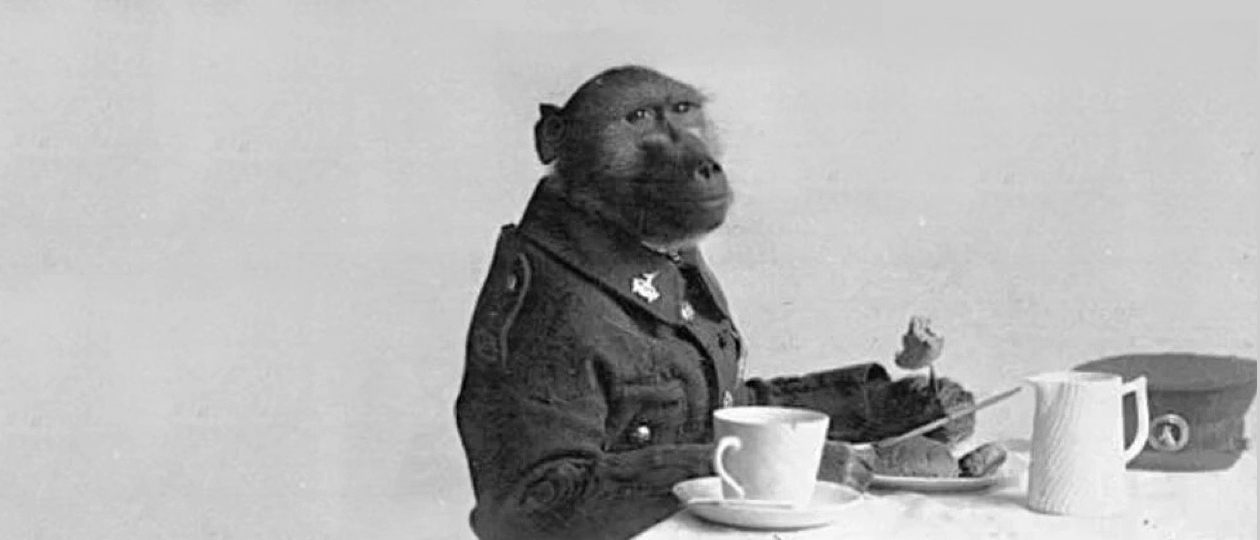
The monkey was paid 20 cents a day and half a bottle of beer a week. Jack worked for nine years, and during this time he did not make a single mistake. In 1890, the baboon died of tuberculosis, and his skull is still kept in a museum in Albany, South Africa.

baboon jack

Yuri Chekalin

Yuri Chekalin is a Professor of Tokyo University, History Department, and a Political Analyst.
He also works as a commentator for EXPODIGEST.


Leave a Reply

Your email address will not be published. Required fields are marked *


About us

The CommentaTHOR.com is an independent magazine of ideas, analysis, and informed opinion.

We believe important events deserve context, historical perspective, and careful examination—not just immediate reaction.

Our coverage spans international affairs, politics, economics, history, and culture through essays, commentary, interviews, and reviews grounded in evidence and intellectual rigor.

Independent of political, corporate, or ideological influence, we encourage open inquiry and informed debate.

By placing current events in their broader historical and cultural context, we help readers understand not only what is happening, but why it matters.

Because understanding begins where headlines end.

P.S. Our News is always up to date and highlights current issues and the most important topics.


CONTACT US

CALL US ANYTIME