 Yaroslav Listov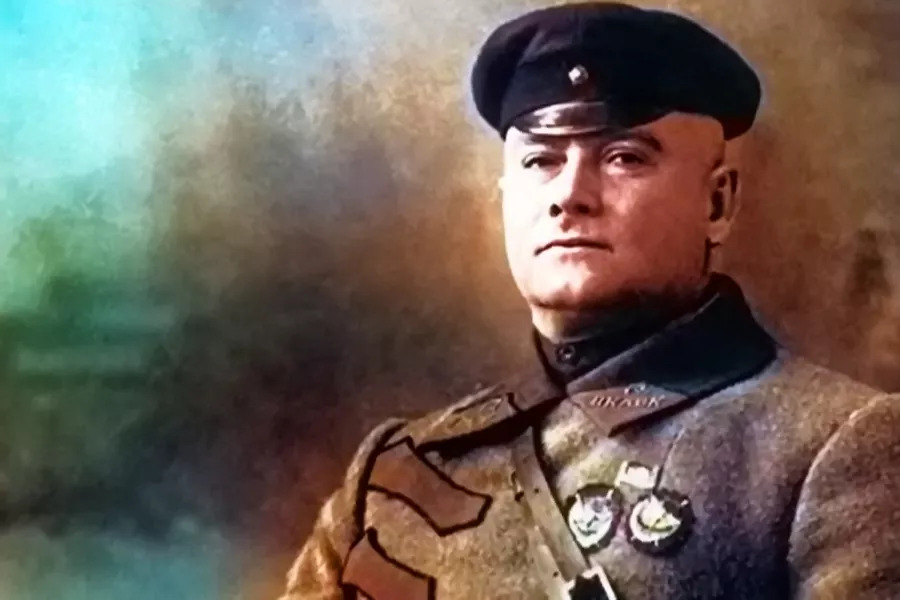
One hundred and forty-five years ago, a man was born whose name became legendary even during his lifetime.
At full gallop he rides,
Bursting into life and immortality—
Grigory Kotovsky, rebel and brigade commander,
A four-time bearer of high honors.
During the revolutionary year of 1905, still unsure of the proper way to fight the ruthless exploiters of the people, he took matters into his own hands. In his native Bessarabia, he organized an armed peasant militia. The militia carried out daring raids on landlords’ estates, setting them ablaze, seizing property and livestock.
Everything they took, Kotovsky distributed among the peasants. The people called him a khotsets—a daring outlaw, a folk hero, a defender of the oppressed. His name spread from village to village: the poor spoke it with admiration and hope, the wealthy with fear and hatred.
At that time, Kotovsky had not yet even heard of the Bolshevik Party. His journey—brief in years but filled with severe trials—eventually led Grigory Ivanovich to what he believed were the true friends of the proletariat and the peasantry. Along the way, he endured repeated blows from the Tsarist secret police.
… 1907. Betrayed by an informer, Grigory Ivanovich was arrested and sentenced to twelve years of hard labor.
… 1913. He escaped from the penal colony. Three years later he was recaptured. This time he was sentenced to death. Unexpectedly, the death sentence was commuted to life at hard labor.
In May 1917, Kotovsky was released. He emerged from prison just as strong, courageous, and uncompromising in his fight against injustice as before. Yet he still did not know where the truth truly lay. Echoes of reckless anarchism still lingered in his character. At last, his meeting with the Bolsheviks determined his future.
He devoted his fearless revolutionary spirit and implacable opposition to all forms of oppression to the service of the working people. Bold raids on White Guard headquarters and the liberation of imprisoned Red fighters became routine operations for Kotovsky’s detachment in Odessa.
After Soviet power was reestablished in southern Russia, the commander of the 45th Rifle Division, Iona Yakir, appointed Kotovsky to command one of his three brigades. The division was surrounded by the forces of Anton Denikin, Symon Petliura, Nestor Makhno, and foreign interventionist troops. Nevertheless, Kotovsky’s brigade, together with the rest of the division, completed an extraordinarily difficult march from Odessa to Zhytomyr. After covering more than 400 kilometers, Kotovsky’s brigade was the first to enter Kyiv after it had been liberated from Denikin’s forces.
At the beginning of 1920, Kotovsky, now commanding an Independent Cavalry Brigade, dealt crushing blows to Denikin’s armies. His beloved Odessa and his native Tiraspol welcomed him as he rode at the head of his celebrating cavalrymen.
General Aleksandr Svechin, formerly an Imperial Russian general and later an instructor at the Frunze Military Academy’s Higher Academic Courses, once addressed his students, many of whom had served under Kotovsky:
“I personally knew Generals Samsonov, Stessel, and Shevchenko (the generals who fought against Kotovsky’s troops). All three were my students. They were knowledgeable and experienced officers, and during the war against Germany they proved they were no cowards. Yet these senior officers—even after stubborn and bloody fighting—surrendered to Kotovsky, who had only six or seven hundred sabers, six thousand prisoners, fourteen armored trains, and large quantities of artillery and machine guns… I simply cannot comprehend it!”
Incomprehensible—yet that is how it happened.
After the end of the Russian Civil War, Kotovsky’s brigade participated in the defeat of Makhno’s and Petliura’s armed formations and helped suppress the peasant uprising in the Tambov region.
Grigory I. Kotovsky formally joined the Bolshevik Party in 1920, although his party seniority was officially counted from his participation in the revolutionary underground in Odessa, dating back to late 1918.
In the victorious Soviet state, Kotovsky became a prominent party and government figure. The people elected him to the Central Executive Committee of the Soviet Union, the All-Ukrainian Central Executive Committee, and the Central Executive Committee of the Moldavian ASSR. His chest bore the highest decorations of the Soviet state—three Orders of the Red Banner for military valor.
Kotovsky himself regarded a fourth distinction as even more meaningful: his award weapon, a ceremonial saber that he carried into battle in defense of the Revolution. This honorary Revolutionary Weapon, bearing the insignia of the Order of the Red Banner and instituted in 1920, was awarded to only twenty-one individuals, among them Semyon Budyonny, Mikhail Tukhachevsky, Kliment Voroshilov, and Mikhail Frunze.
 Yuri Chekalin
 Sergey Stankevich