Egor Yakovlev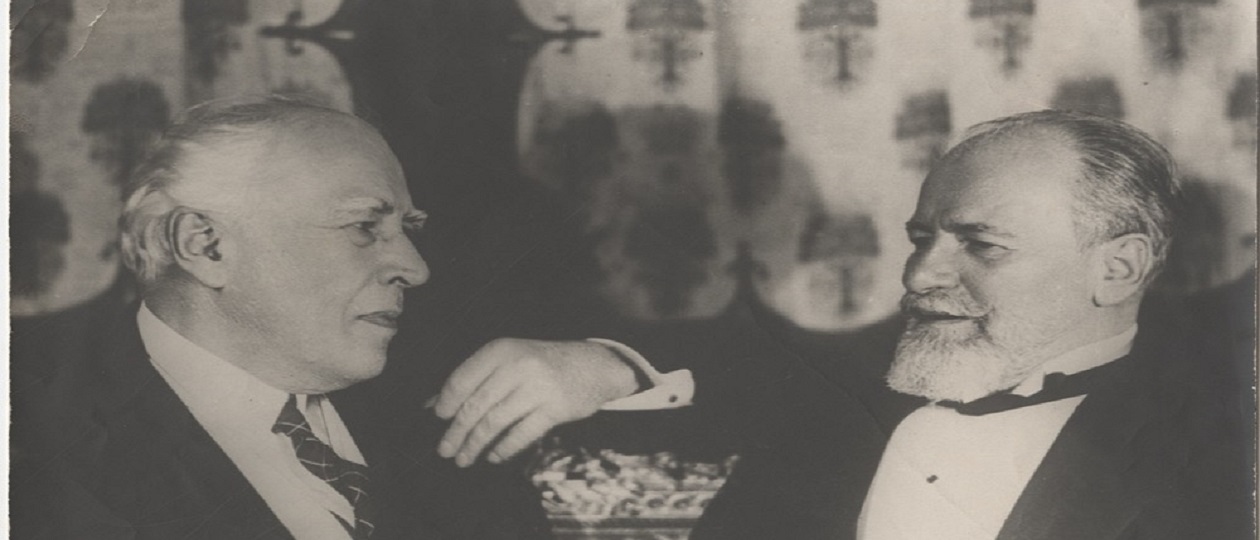
Russian and Soviet theater director, teacher, and founder of the Moscow Art Theater, Vladimir Nemirovich-Danchenko, was born on December 23, 1858.
Nemirovich-Danchenko became fascinated with theater while still in high school. He set up a “windowsill theater” in his room. The young director assembled a troupe of actors from playing cards: kings, jacks, and queens. On a toy stage, they became the heroes of all sorts of plays. Nemirovich-Danchenko, immersed in his first performances, raised and lowered the curtain, sang overtures, and conducted invisible musicians. In fourth grade, he composed two plays and later participated in amateur theater groups.
His passion for theater reached such a level that in 1879, Nemirovich-Danchenko dropped out of university. He began writing plays and reviews of productions, sharply criticizing the Imperial Theatres’ repertoire. Nemirovich-Danchenko boldly criticized acting, believing that “…the famous Russian art, proclaimed by Gogol and Shchepkin, was increasingly overgrown with cliches, conventions, sentimentalism, and was becoming stagnant.”
By the early 1890s, Nemirovich-Danchenko was known not only as a playwright and critic. He taught in the drama department of the Musical and Drama School of the Moscow Philharmonic Society. Olga Knipper and Vsevolod Meyerhold studied under him. Nemirovich-Danchenko believed that “theater should be the embodiment of a person’s spiritual life, a department of public education.” But the theater of his time did not meet these requirements. Change was needed.
In 1897, a fateful meeting took place between two of the greatest theatrical figures. Nemirovich-Danchenko invited Konstantin Stanislavsky, a figure still quite new to the stage world at the time, to the Slavic Bazaar and proposed creating a new theater. They talked for 18 hours, discussing artistic ideals, finances, stage ethics, technique, plans…
Nemirovich-Danchenko and Stanislavsky were among those who created the director’s theater. While previously, the director on the imperial stage had been primarily an administrator with a vague scope of responsibilities, under Nemirovich-Danchenko, the director emerged in a more familiar role.
“The director,” Danchenko wrote, “is an interpreter, and at the very moment—as soon as the actor begins to try out what’s proposed, to embody what’s intended—the director is a mirror, refracting the performer’s mistakes and discoveries. And right there, too, is the director-organizer, able to survey the whole, directing all the components of the performance toward the ultimate goal—the embodiment of its idea.”
A year later, Stanislavsky and Nemirovich-Danchenko opened the Moscow Art Theater (MKhT).
 Kamil Askerkhanov
 Sergey Stankevich
 Yuri Chekalin